Netflix for games just got its post-mortem
Garry Newman says a menu of 60 games doesn't work and never will — three weeks after Meta, Google and Xbox all bet on the model.

Three of the largest companies on earth have spent the past month betting on the same idea. Meta launched Horizon Create and Studio on 24th September. Google launched Playground on 7th October. Xbox stood up LABS on 13th October, measuring its success by whether more people are playing and creating.
On 15th October, the man who invented the modern user-generated sandbox published a post-mortem explaining why the idea doesn't work. He has the advantage of having already tried it.
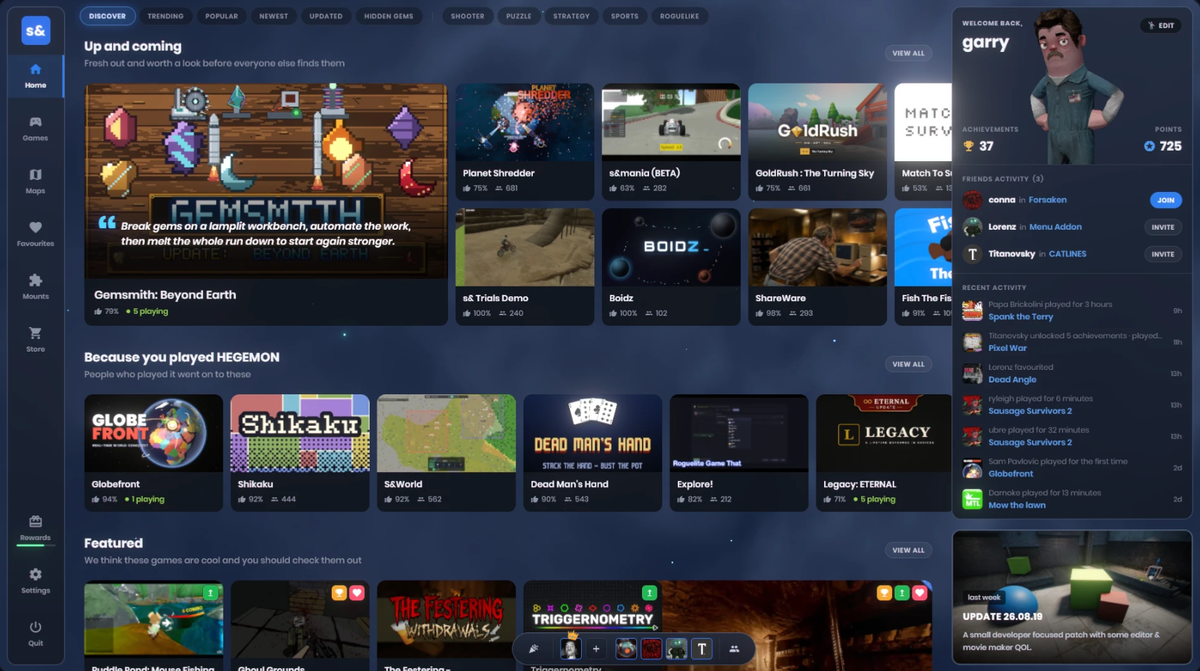
Garry Newman's S&box is Facepunch's spiritual successor to Garry's Mod, released earlier in 2026 as an open-source development platform wrapped around a hub of player-made games.
It has not gone well. Mixed reviews, weak retention, and — the detail that should interest anyone watching this space — it filled up with low-quality AI-generated games almost immediately.
Newman's announcement, posted to Steam and the game's own site, is unusually unguarded for a studio head. He writes that the platform is not well liked, that it doesn't have good retention, that he is embarrassed by the reviews and ashamed of them. Facepunch focused on the engine and the development experience because that is the part they enjoy, he says, but they are not selling an engine. They are selling a game, and the focus has to move to what players experience rather than what developers do.
Then the diagnosis. His idea of a 'Netflix for games' does not work. It isn't feasible. It isn't how people discover games. You cannot land on a menu of 60 games and tell them to have fun. People find games through recommendations and through watching streamers and content creators. The goal should not be the platform with the most games available, but the platform with the best and most popular ones.
He is careful about where AI sits in this. The root cause, as he sees it, was his own curation philosophy. The flood of hastily assembled AI games didn't create the problem so much as make surfacing quality much, much harder. That distinction is the first documented case of a user-generated platform being degraded by machine-made content at launch, and the honest version is it's more useful than the version where AI is the villain.
The remedies are instructive too. S&box goes free-to-play towards the end of 2026, with existing buyers receiving Steam inventory items scaled to whether they paid $10 or $20. Facepunch will push hard on the Sandbox Game itself, aiming for parity with the Garry's Mod version and then beyond it — more NPCs, vehicles, proper multiplayer, and addons. And the cartoonish citizen character models are being replaced with ordinary human ones, explicitly so the thing stops looking like Roblox.
But while Newman had sixty games and could not make discovery work. Meta and Google are proposing to have a lot more than sixty. The interesting part of his diagnosis is more precise than the headline suggests, and it cuts differently across the three platforms that just committed to this.
What Newman says fails is the menu. A gallery you arrive at and browse, where the platform's job is to present a catalog and the player's job is to pick. What he says works is social discovery — a recommendation from someone you know, a streamer you watch, a multiplayer session with people already in it. The difference isn't size. It is whether games reach players through a list or through other people.
Read that way, Google has built the thing he is declaring dead. Playground publishes to an Explore gallery, surfaced by player ratings and activity metrics. That is a menu with a sorting algorithm attached, which is still a menu.
Meta has built something closer to what Newman says actually works. Horizon games publish natively into Facebook and Instagram feeds, with Play Games-style profiles, creator following and leaderboards.
Games arrive next to the people who made them, inside a social graph, in the place where recommendation already happens. Whether Meta's discovery ranking is any good is a separate question — games there earn reach through engagement, stability, cultural relevance and retention, which is an algorithm nobody outside Meta can inspect. But structurally it is a feed, not a catalog, and Newman has just spent a paragraph explaining why that matters.
The obvious objection to all of this is scale, and it deserves stating properly. S&box had no audience. Facepunch had to generate demand from nothing, which is the hardest problem in the business and precisely the one Meta and Google do not have. Billions of existing users and an installed distribution surface might make a menu work where an independent studio's could not. Newman's failure may be a distribution problem wearing a model problem's clothes.
Except his argument isn't really about audience size. It is about the shape of the thing. A menu of sixty is bad because sixty strangers' games are not a proposition, and a menu of 60,000 is worse, not better, which is the point he makes when he says the goal should be the best games rather than the most.
The last thing worth noting is the pricing move, because it is the third time this month the same answer has surfaced. Newman concluded that getting players through the door matters more than charging them at it, with revenue coming from in-game items afterwards.
- Google gates Playground creation behind a Google One tier subscription and has disclosed no creator revenue share at all.
- Meta promised in-game monetization and a Creator Fund with details to follow.
- Roblox, the only one with a working creator economy, has seen its stock drop 42% partly because it deliberately suppressed its own monetization in favor of retention.
Four creation platforms, four different unresolved answers to how the money works, and the only operator with a completed experiment has concluded that the correct price of entry is nothing.
Newman is running a much smaller business than the three companies that just followed him into this, and his conclusions carry the bias of someone explaining a disappointment. But he is also the only one of them who has already found out, and what he found out was that the hard part was never making the games available. It was getting anyone to care.