Why Atomontage uses the 3D format an AI can actually edit
Splats can't be edited, meshes break when described, and voxels cost you frames.

The question nobody asks about AI-generated 3D is which format the agent is supposed to handle. Most of the industry has answered it badly, and a fifteen-person company in Bratislava may have stumbled into the right answer by accident.
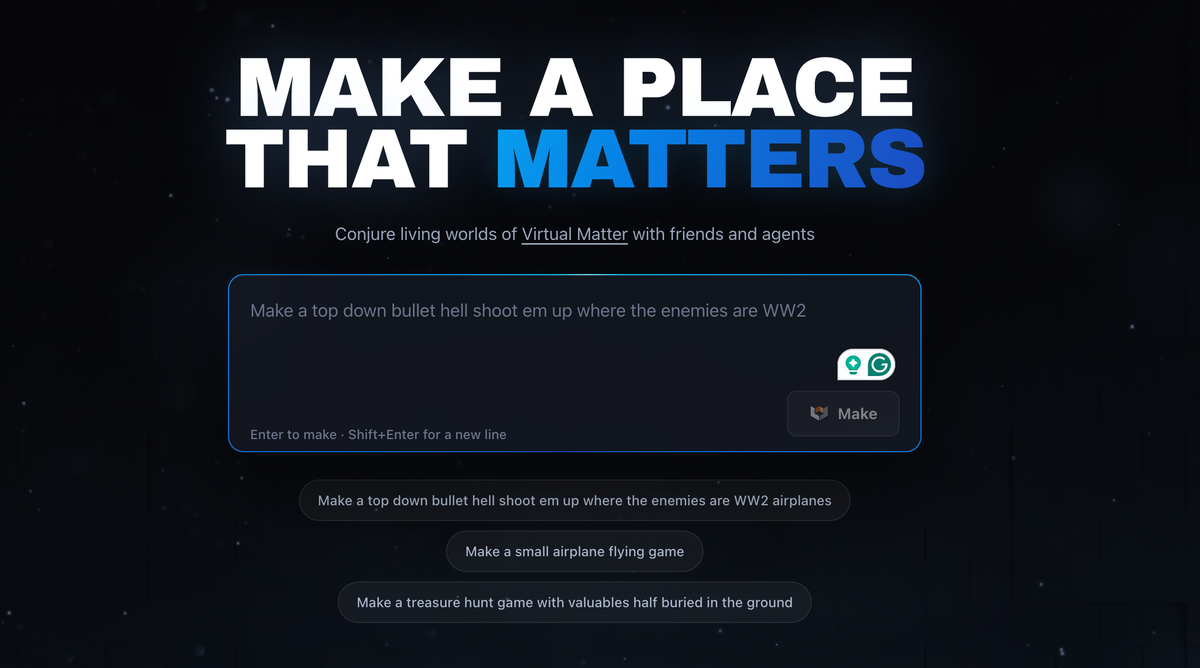
Atomontage has been working on voxels since 2015, and its CEO Branislav Šiles spent roughly a decade on independent voxel research before that. Its platform, Virtual Matter, soft-launched at virtualmatter.ai in June. It is free, runs in a browser with no signup and no install, works on a phone, and you can use it right now.
Under the hood, it is a C++ engine cross-compiled to WebAssembly rendering through WebGL2, with cross-origin isolation enabled so it can use SharedArrayBuffer for multithreading. Simulation is server-authoritative with a Lua scripting layer, driven by a command-line tool, and it hot-reloads.
The company's positioning claim is that progressively streaming microvoxels unlock things that large voxels, polygon meshes, Gaussian splats, and world models structurally cannot.
It is worth being precise about what Atomontage has and has not done. This is not an engine designed for AI. It is a decade-old voxel engine with a conventional Lua API and an agent harness fitted on top.
A publicly accessible project page on the platform makes the workflow visible: the agent reads and edits Lua files by line number, drives the engine through its command-line tool, verifies its own arithmetic against the running server, and commits. That is a coding agent working on a codebase, not a bespoke creation model.
The company is explicit about it too. Alongside its own prompt box, the site tells you that if you have your own harness you can point Claude, Codex or Cursor at a command-line entry point and use your own subscription.
A fifteen-person studio has arrived at the same conclusion Unity did last month — meet the agent where it already lives — with the useful side effect of pushing inference costs onto the user.
However, the decision to use voxels comes with its own compromises. Voxels scale with volume rather than surface area, which is why a mesh can represent a hollow building with a shell while a voxel grid must account for the space inside it.
That volumetric quality is precisely what makes the edit primitive simple enough for an agent to write and what makes large edits expensive. The property that makes the format machine-authorable is the property that costs frame time.
Which means the marketing promise and the engineering constraint are the same thing. Deep destructible interactivity is the pitch but destruction at scale saturates the update thread.
Aside from the technology, it's also worth pointing out the scale of the company. World Labs has raised around $1.2 billion to produce geometry that game pipelines struggle to ingest. Meta announced prompt-to-game tools at Connect in September with a waitlist and no availability date.
Atomontage has raised somewhere around $6 million across reported rounds — the figures vary by source, with angels including Resolution Games' Tommy Palm and Fenris chief executive Hilmar Pétursson — and shipped something you can play in a phone browser.
The caveats are real, and the company's own president supplies the sharpest of them. Daniel Tabar readily notes that voxels are not new and that respected developers including Ken Silverman and Jon Olick attempted this and moved on, attributing Atomontage's persistence to compression and mobile rendering work that others abandoned. That is an argument about engineering integration rather than algorithmic breakthrough, and the telemetry supports exactly that reading: the cost curve is intact, and it is being managed rather than solved.
No user numbers, revenue or retention data have been disclosed. The compression and streaming claims remain unverified. And $6 million against Meta's distribution is not a contest on any timescale that matters.
But the representation argument stands independently of whether this particular company wins. If agents are going to author 3D, someone has to decide what they hand over. Splats cannot be edited. Meshes break when described. And voxels cost you frames.
That is the actual choice, and almost nobody is articulating it that way.