Even 40% of Godot's anti-AI indies are using AI
Godot's poll didn't ask about AI in 2025. In 2026 it had to.

For years, Godot's annual community poll has mapped the same terrain: engine versions, GPUs, revenue methods, team size. It's a survey designed to track the slow-moving aspects of this open-source game engine and the people who use it.
This year, for the first time, it asked not one but two questions about AI.
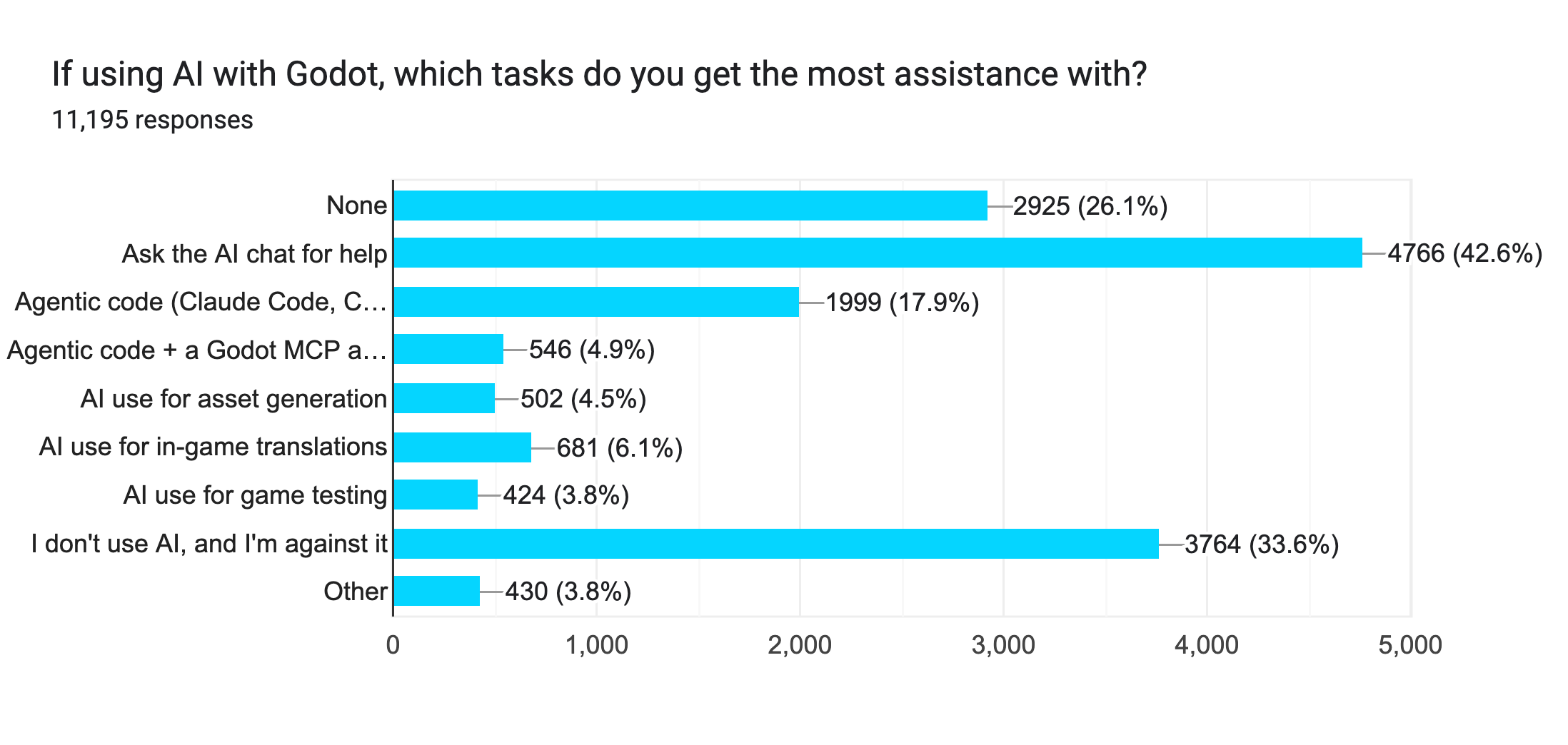
What the new questions found is a confused picture. Asked which AI-assisted tasks they get help with, it's a multi-select question, so answers overlap;
- 42.6% of respondents said they use AI chat for help, and
- 17.9% use agentic coding tools like Claude Code or Codex, but
- 33.6% explicitly selected "I don't use AI, and I'm against it".
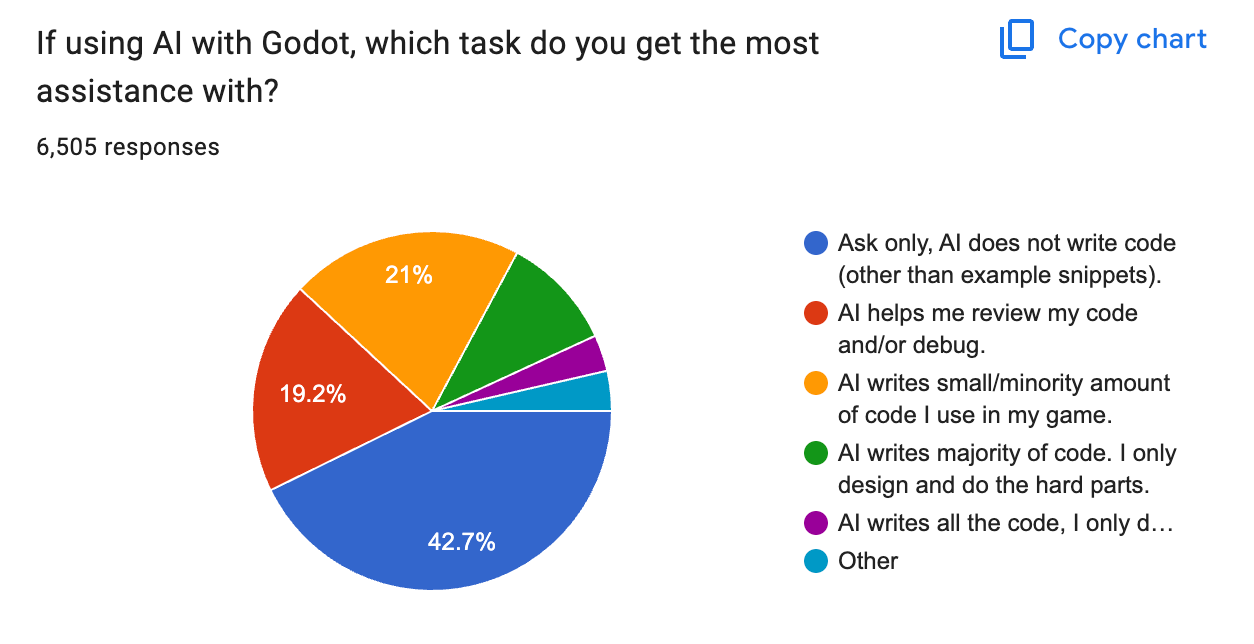
Dig into the follow-up question, only asked of the roughly 6,500 respondents who said they use AI at all, and the adoption looks shallower still, with 42.7% saying AI never writes their code at all; it's consultation only.
Add in the group who use it strictly for review and debugging, and nearly two-thirds of self-identified AI users aren't letting it generate code for them. Only about one in ten let AI write the majority of their project's code, and just 3.3% hand over all of it.
Naturally, this is an overwhelmingly hobbyist population; 86.1% of respondents build in Godot as a hobby, with only 4.5% doing paid, professional work. Godot itself is the open-source alternative to Unity and Unreal, chosen disproportionately by developers already inclined toward do-it-yourself, non-corporate values.
If any corner of game development was going to resist AI tooling on principle, this is a reasonable candidate.
After all, on 30th June, the Godot maintainers formalized new contribution rules aimed squarely at the flood of low-quality, AI-generated pull requests that had been piling up in the review queue.
However, even in this environment, basic AI use already reaches a majority of this specific audience, even as a third of them say so on the record in opposition.
Of course, without a matching 2025 baseline, we can't comment on how quickly AI adoption is happening here. But, if nothing else, the fact is 2026 was the first year Godot felt the subject of AI had become unavoidable, even for its community.