EA switched off Need for Speed: Underground 2's servers in 2006. 14,685 people are playing it right now
Claude Code has rebuilt Need for Speed: Underground 2 for browser with online multiplayer.

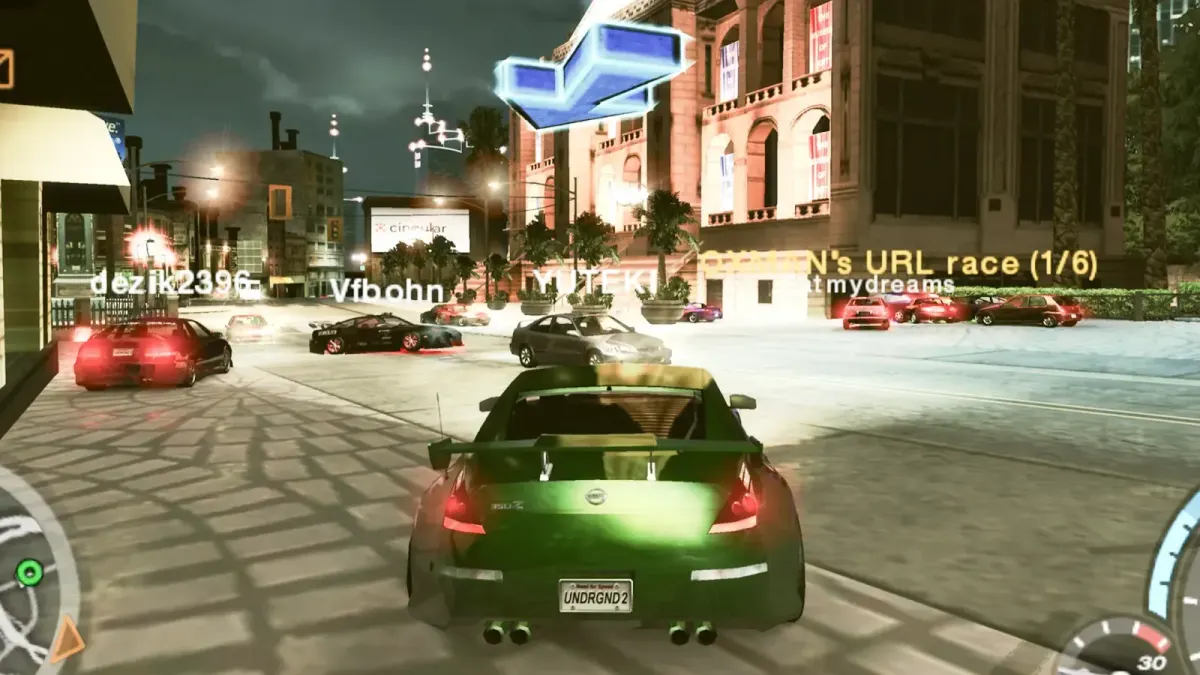
On 4th November, Anthropic narrowed the rule that stops Claude Code rebuilding specific existing games. Two hours later, XDA published a piece about a browser-playable rebuild of Need for Speed: Underground 2, with online multiplayer, built with Claude Code.
The rule never came near it, and the reason is the most useful thing to understand about AI and game IP right now. Nobody prompted "Rebuild Need for Speed".
What was asked for was a static recompiler. The project, which its developer th0mk calls Underground 2 Revived, takes the game's x86 code and translates it to C ahead of time, then compiles that to WebAssembly. Direct3D 9 is translated to run on WebGPU. The sound goes through Web Audio and an AudioWorklet. The game's threads run as browser workers over one shared memory. The module the site serves is around 37MB. It is not emulation, and it follows the method established by N64: Recompiled and XenonRecomp.
It builds on NFSU2Recomp by Talha Müderrisoğlu, the original x86-to-C recompiler for the game, which produced an ARM64 macOS build with Direct3D 9 translated to Metal. Both projects name the tool. Müderrisoğlu's README says development was carried out with an AI coding assistant, Claude Code, under the direction of the project owner. Th0mk's credits end with the line that it was built with the help of Claude Code.
The IP exposure was not generated by a request to reproduce a game. It was generated by requests to write compiler passes, a graphics abstraction layer and a netcode server — work that is entirely legitimate in isolation, that no reasonable rule would refuse, and whose output happens to be a commercial racing game from 2004 running in a browser tab.
The multiplayer is the part that makes it more than a port. EA's own servers for the game closed in 2006, so the free roam and racing run on a Rust server written for this project. That is not a restoration of something EA switched off. It is a new online service for an EA game, operated by someone else.
People are using it. The site publishes live counters, and when I looked they read 14,685 playing, 5,561 of those in free roam and 905 in races and lobbies.
Set that against what the rule actually governs. Addy Osmani's update says you can now name a game to describe what you want and get an original game in that genre, and that asking for a copy of the original gets you an offer to build something similar instead. That is a rule about the request. It reads the prompt, decides whether the prompt is asking for a copy, and responds accordingly. It has no view on what a toolchain eventually produces, because at no point in building a recompiler does anyone type the sentence it is watching for.
Which gives us a precise account of how far off target it is in both directions at once. In the same week, Tom's Hardware documented Opus 5.5 refusing anti-cheat development, security reviews and product activation research, none of which infringes anything. And two projects that rebuild a live EA trademark shipped without obstruction. A model that declines "make me X" while writing the compiler that produces X is not a constraint on copying. It is a constraint on phrasing.
The genuinely interesting legal detail is that the code is careful and the deployment is not.
Th0mk's repository does everything the recompilation scene has learned to do. It is MIT licensed, it states that you bring your own copy of the game, and it says plainly that the repository contains none of the game's code or data. Building it requires your own SPEED2.EXE, patched to version 1.2 North America, matching a stated byte size and SHA-256. Generated C and compiled output are never committed because they are made from the game. Müderrisoğlu's project takes the same approach and also requires the user's own copy.
The website is a different matter. The data manifest that nfsu2.xyz serves to every visitor enumerates the game's own asset files — car geometry, textures, vinyls — and anyone arriving at the page can simply press Play. PC Games Hardware reached the same conclusion, that the site streams EA's data without a licence.
The entire rights mechanism is a line in the footer: a fan project notice disclaiming any affiliation with Electronic Arts, and an email address for rights holders. EA has said nothing publicly. The same reporting notes Take-Two having a browser port of GTA: Vice City taken down as the obvious precedent.
There is a smaller story underneath about how quickly control slips. Müderrisoğlu published NFSU2Recomp under MIT and then relicensed it. The README now states that the repository is not open source, reserves all rights, permits personal non-commercial use only, and requires prior written permission for any modified version, port, fork or build, as well as for any commercial use. It says a license change became necessary later, and that people who obtained the early versions may continue under MIT's terms. th0mk forked the MIT-licensed version of 16 October 2026 and says the project uses only code from it.
That is almost certainly lawful, and it is a neat demonstration of the pace. An author moved to stop other people porting their work, and the port that mattered had already been built inside the window — by someone using the same AI assistant the original was built with.
All of which makes this the live test of the two positions platform holders took last month. Asha Sharma described games being rapidly decompiled and ported into the browser through WebAssembly as an unmistakably good outcome for players, and stood up a division to explore it, without saying where the line sat. David Baszucki, asked the same question about Roblox importing any existing game, answered that Roblox expects to respect IP and DMCA takedown and wants licensed IP on the platform.
Here is the case both of them were describing. It is a specific commercial game, rebuilt by two people with an AI coding assistant, served to roughly fifteen thousand concurrent players over infrastructure the rights holder does not control, and its entire licensing apparatus is a mailbox nobody has written to yet.
The argument has been about who governs AI in games, and the answers have been rules about prompts: disclosure fields, usage policies, two sentences in a system prompt.
But this is what the work actually looks like when it reaches the thing those rules exist to protect. It does not look like a prompt. It looks like a compiler.