Roblox is dealing with AI slop, ranking by retention
AI usage is exploding. Roblox is applauding.

"Surfacing New Content vs. AI Slop" is a section heading in a Roblox shareholder letter. It may be the first appearance of the phrase in a document filed with the SEC.
What sits under the heading is the only answer to the slop problem that does not involve gatekeeping, and it is worth highlighting compared to everything else the industry has tried.
Roblox does not filter AI content. It does not require creators to disclose it. It does not employ curators. It reranks. From Q2 2026, the company began optimizing its Recommended For You (RFY) algorithm for long-term retention rather than immediate engagement, and in Q3 it refined the personalization further, including by weighting age-cohort data.
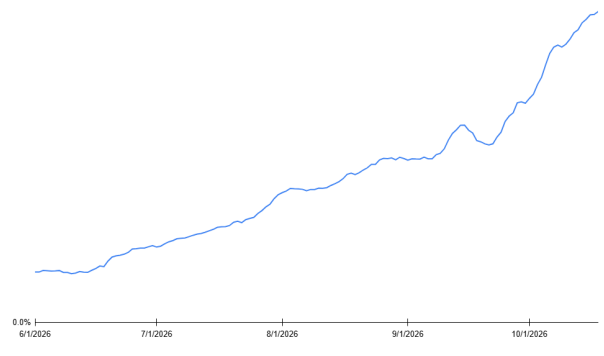
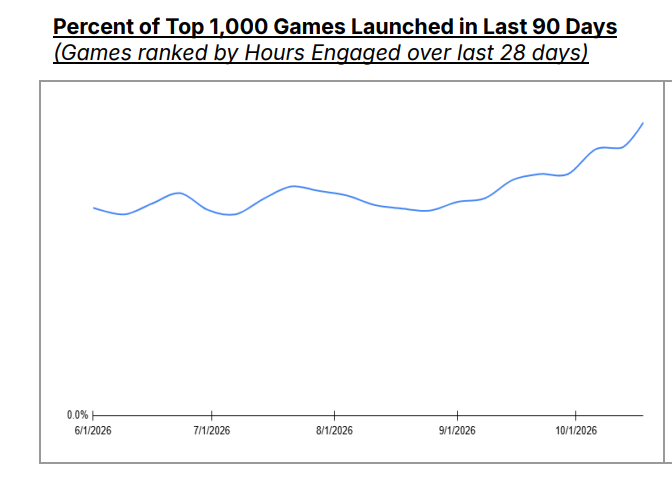
The result it reports in the Q3 2026 letter is that by the end of the quarter, around 40% of the weekly RFY top 100 games by impressions had been created in the previous three months.
On the call, CEO Dave Baszucki described the challenge as finding the great new content within more content, and said the algorithm is pushing more dynamic content to the surface. CFO Naveen Chopra put the commercial case: the RFY-driven lift in engagement and retention translates to higher user lifetime value over time. The letter claims the changes improved both retention and monetization and positively affected bookings, with year-on-year growth in bookings per hour improving relative to the prior quarter.
Line that up against the other positions taken and it is a fifth, genuinely distinct one.
- Itch.io certifies a declaration and lets players filter on it.
- Pantaloon certifies a human judgement and charges five dollars a month for it.
- Anthropic certifies nothing because it intervenes at the point of creation instead, a rule it has already had to narrow.
- Google and Meta have nothing to certify, because everything made on Playground and Horizon Create is prompted into existence.
- Valve has conceded the problem and declined to act on it.
- Roblox certifies nothing and ranks everything.
Crucially, it is the only one that scales. A ranking answer requires no honesty from creators, no human in the loop, and no catalog to split. It behaves identically whether 1% or 100% of the content is synthetic, which means it does not degrade as the supply goes AI-native — the specific failure mode waiting for every disclosure-based system.
Roblox's discovery models are trained on billions of daily signals: what users see, what they play, how long they stay, who they play with, what they return to. None of that asks how a game was made.
It is also the only one of the five that cannot be checked by anybody outside the company.
Retention and lifetime value are proxies for quality. They are not quality. A game that holds a thirteen-year-old for forty minutes has demonstrated that it holds a thirteen-year-old for forty minutes, which is a commercially useful fact and a fairly weak aesthetic one.
Itch.io's disclosure field is unverifiable but at least legible: you can see the claim and decide what you think of it. A ranking model is the opposite. The company grading the content is the company being graded, the grade is a bookings number, and there is no external view of the working.
And there is a reading of the timing that the published data cannot rule out. The retune happened in a quarter when hours engaged fell 15% year-on-year and daily users fell 9%.
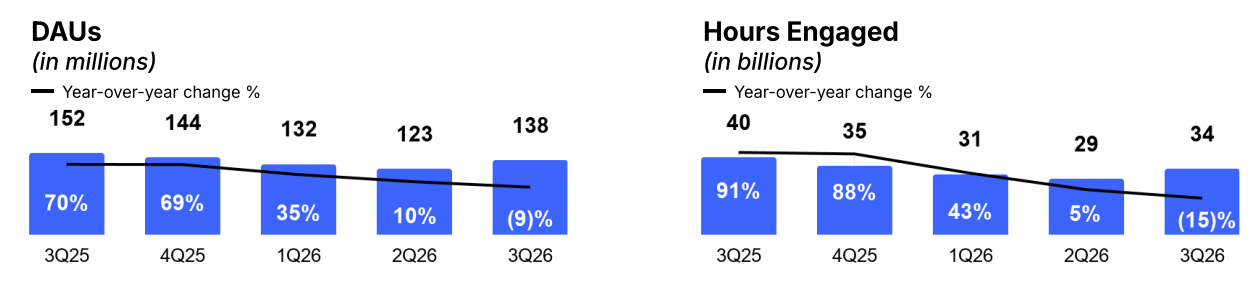
Surfacing new content faster improves retention, which is what Roblox says it did. Surfacing new content faster is also exactly what a platform does when it needs novelty to hold an audience that is shrinking. Those two explanations produce identical numbers, and the letter reports the second set of facts eight pages after the first.
Where this gets genuinely interesting is what the ranking is being pointed into. Roblox is building Moments, which brings off-platform video directly into the Roblox app with every video one tap from active gameplay. It is live across most of the US, and now supports buying avatar items straight from a video and commenting on it. In the coming months, the letter says, games made using the the new AI Build tool will be playable directly from the Moments feed.
Prompt-made games, surfaced by an algorithm, inside a short-video feed. That is the entire stack of the thing, and it is a direct answer to the problem Garry Newman ran into. He concluded in October, after abandoning his Netflix-for-games idea, that you cannot land people on a menu of sixty games and tell them to have fun. Roblox has reached the same conclusion and built the feed.
Which is why the slop debate everywhere else looks increasingly like the wrong argument. Valve, itch.io, Pantaloon and Anthropic are all arguing about what should be allowed on the shelf.
Roblox has decided the shelf is the wrong object, that abundance is not a contamination problem but a sorting problem, and that whoever sorts best wins. If the letter is right that attention and connection are what become scarce when content becomes abundant, that is almost certainly the correct conclusion.