Roblox's World-Model AI experiment shows why games still need engines
Roblox's world-model research is interesting because it shows why games remain such a hard medium for generative AI.

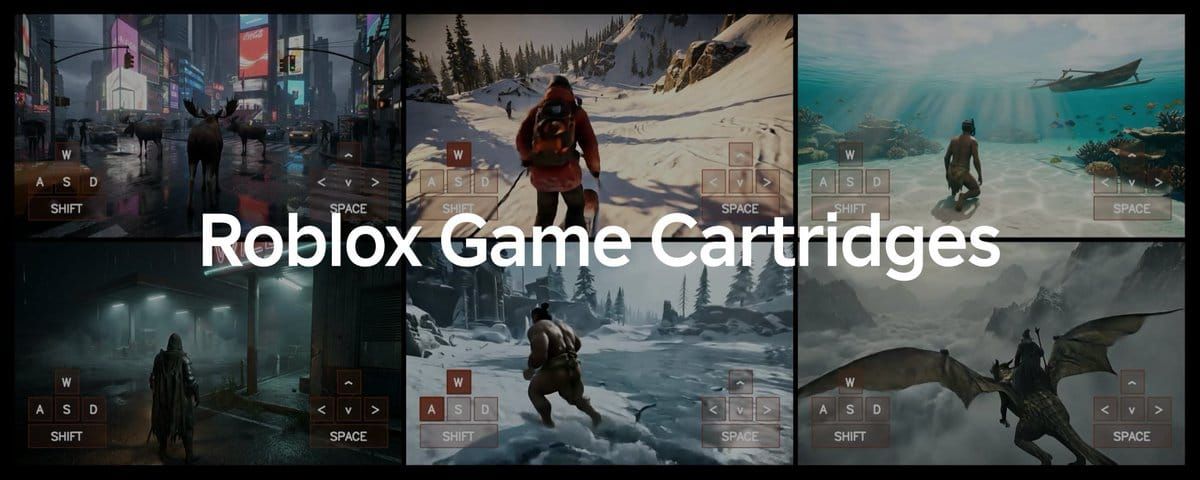
In its mission to become the "highest-fidelity, interactive, multiplayer gaming platform", Roblox has been aggressively researching AI.
Its latest experiment has been with action-conditioned video world models. These are systems that generate video in real time in response to player inputs.
In its most recent research demo, Roblox says it trained a 14-billion-parameter text-image-to-video model running at 24 frames per second, then handed it to internal developers to see whether they could build something recognisably game-like around it. The result is not a finished product, but it is a useful technical signal about where this field is heading.
The important point is that the video model is not the game. It is a generative rendering layer. It can create moving images that look like worlds, react to movement prompts, shift visual style, and produce physics-like effects that would be hard to hand-author in a conventional engine.
But that does not automatically make it a game. Games require durable state, legible rules, goals, feedback loops, object permanence, progression and repeatability. A player needs to know not only that something appeared on screen, but that it exists as part of a coherent system.
Roblox's solution is what it calls a "Game Cartridge": a programmable harness that couples the video model to the Roblox engine.
In this setup, traditional Luau code handles the abstract game state — variables such as health, inventory, quest progress, scene transitions and score — while the video world model generates the visual experience.
A separate vision-language model observes the generated frames and acts as a perception layer, checking whether certain visual triggers have occurred. For example, if the player appears to collect an energy canister, the VLM can fire a callback to the code harness, which then updates the underlying game state.
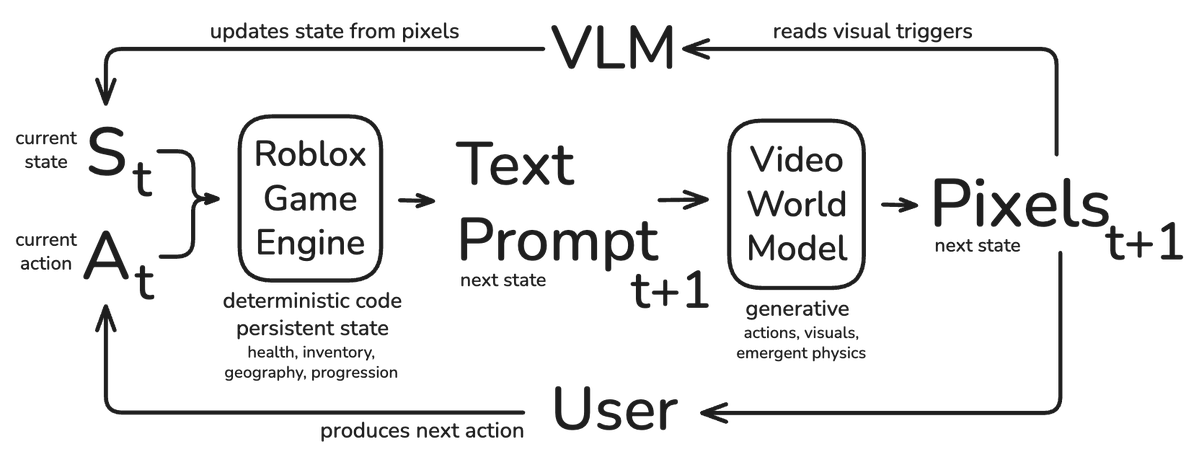
That architecture is both clever and revealing. It turns the video model into something closer to a responsive stage or visual simulator, while the actual game logic remains deterministic and programmable. The VLM becomes a bridge between the unstable pixel world and the structured logic layer.
In technical terms, it is being used almost like an external reward or event detector: has the player done the thing the game needs to recognise?
This is a sensible compromise. It avoids pretending that a video model can maintain the entire ontology of a game world by itself. Current video models are good at producing plausible transitions; they are much weaker at maintaining strict object identity, spatial consistency and long-horizon causal state. Those are not minor details. They are foundational properties of games.
Roblox is explicit about some of these limitations. Object placement remains difficult because text prompts are not naturally anchored to a stable 3D coordinate system. A prompt such as "a canister appears in front of the character" can break if the player turns around or walks away, because "in front" is relative and unstable. A more grounded instruction, such as placing the canister at the base of a tree, works better because the tree gives the model a more persistent reference point.
Long-horizon consistency is another problem. Models trained on short clips can lose track of where they are in a sequence. Roblox gives the example of a rocket launch. If the model is rolled forward for too long with the wrong prompt, it may loop through launch-like behaviour repeatedly rather than understanding that the rocket should now be in space. That is a good illustration of the gap between visual plausibility and game state. The model can generate "rocket launch-ness", but it does not necessarily know the event has already happened.
Visual consistency is a related issue. Characters and objects can drift when they leave view and return. A game engine maintains identity through explicit data structures: this object has this mesh, this transform, this inventory state, this physics body. A video model maintains identity through conditioning and recent context, which is much softer. That may be acceptable for dreamlike experiences, prototypes or aesthetic exploration, but it is a problem for games where players expect systems to be reliable.
The strategic implication is not that AI replaces game engines. It is that game engines may become harnesses for generative presentation layers. The engine holds the canonical state. The model provides the visual richness, style variation and rapid authoring capability. This is a more grounded version of the "AI-generated games" thesis than the idea that a prompt will simply replace a development team.
For Roblox, that matters because its platform is built around user creation rather than fixed authorial control. A tool that lets creators rapidly sketch worlds, test moods, generate scene variations or prototype quest structures could be valuable even if it is nowhere near production-grade game generation.
The near-term use case may be previsualisation, interactive concepting and experimental social experiences, not robust commercial games with complex mechanics.
There is also a more subtle point here. By wrapping the world model in a code cartridge, Roblox is preserving what makes games games: authored systems. The generative model expands the expressive surface, but the designer still defines the loop.
That's probably the right balance. Pure neural generation gives you surprise, but games also need constraint. They need failure conditions, persistence, consequences and rules players can learn.
So the cautious conclusion is this. Roblox has not shown that world models can independently make compelling games. It has shown a plausible way to make world models usable inside game-like experiences. That is less spectacular than the hype version, but more credible. The future may not be neural engines replacing game engines. It may be generative flash constrained by deterministic engines.