Roblox targets first-time creators with new AI Build app
Roblox's new mobile Build tool turns text prompts into playable games.

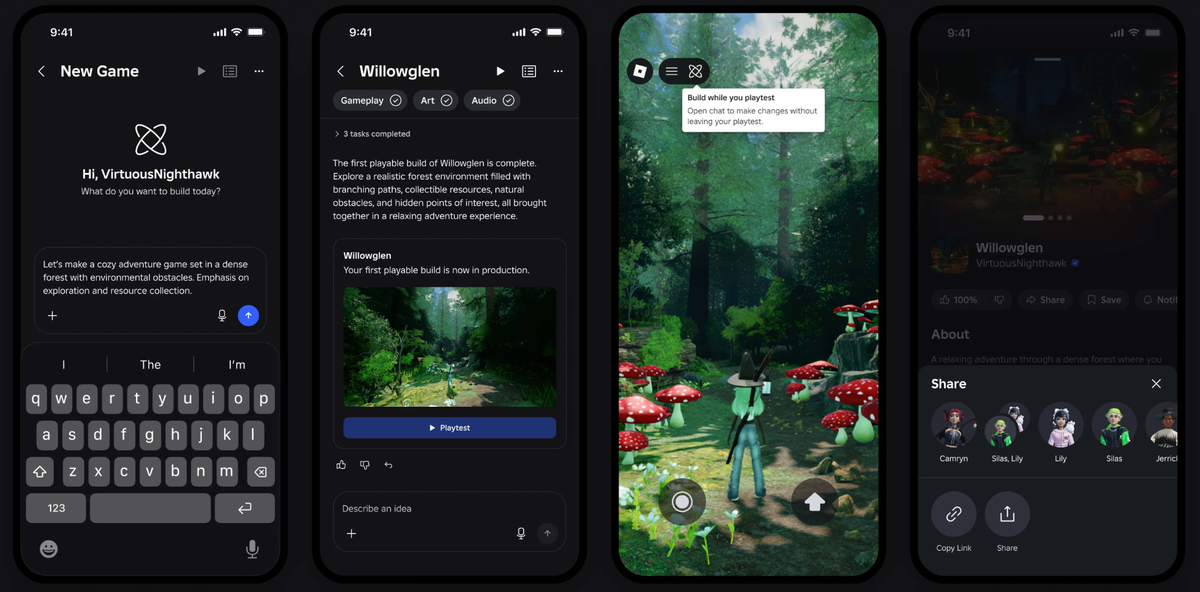
Continuing its aggressive deployment of AI, Roblox has announced its new mobile game-making app Build.
It's a new way to create a game entirely from a phone, described in a prompt rather than built in an editor. What's really significant, however, is that the mobile app is part of the same pipeline as Roblox Studio, the desktop tool the platform has run on for two decades.
The mechanics are straightforward. You type a natural-language description, such as "an obstacle course in a haunted mansion," and the AI generates a starter experience from it: mechanics, environment, characters, art style, and sound, all in one pass. There's no Lua scripting and no 3D editor to learn.
And because Build shares its backend with Studio, it means your project doesn't live in a separate, lesser mobile silo. You can start a game on your phone with Build, then open the exact same project in Studio on desktop to refine it properly: add real scripting, tune physics, build out systems Build's initial generation couldn't handle.
You can also work the other direction, kicking off an AI build agent from Studio and checking its progress, or nudging it, from your phone later. Roblox is framing this as one continuous creation pipeline with two entry points, not a stripped-down toy version of the real tool.
The model stack behind Build is reportedly a mix of open-source and proprietary Roblox-built models. It sits on top of AI infrastructure Roblox has been assembling for a while.
The company already has Cube 3D, its generative asset model for producing 3D objects from text and images, and has been building out what it calls 4D and world-model tooling for generating and evolving game environments over time, alongside a developer-facing chatbot assistant for scripting help inside Studio. Build appears to be the mobile, prompt-first front end sitting on that same underlying stack, rather than a one-off feature built separately from it.
CEO David Baszucki didn't frame the launch as a product announcement so much as a mission statement, and it's worth quoting at length because the framing tells you where he thinks this is going.
"For 20 years, Roblox has been on a mission to remove limits on what gaming is – and what it can be," he wrote, before getting to the actual justification: "We're doing this for one reason: The world needs more play."
From there, the post reaches further back than gaming as a category at all. "Play is humanity's oldest technology for connection and learning. Before agriculture, before commerce, before civilization, we played together." The role he assigns Roblox in that story is specific: "to remove every obstacle between that play and the people who want to create it. Faster iteration and fewer technical constraints. And more room to push further than a single creator – or a small team – could have gone in the past."
He's also explicit about who this is aimed at. Not the studios already succeeding on the platform, but "first-time creators – who were often Roblox players first – with a single focused idea," the population Studio's desktop-and-scripting requirement has always screened out hardest.
Build itself is framed as only the opening move. Baszucki says Roblox will "incrementally roll out" more of this, "new tools for creators, new ways for players to play, and new ways for people to find the things they love," between now and RDC, the company's annual developer conference.
The rollout is deliberately narrow to start. Public alpha begins in New Zealand on July 28, age-gated at 9+ to use the tool and 16+ to publish globally, free at a basic tier with paid options for heavier users planned as it expands.
It's a small test market, but the architecture underneath, one shared backend spanning phone and desktop feeding the same broader AI stack Roblox is building for its existing developer base, is the part worth watching.