Sony is aggressively deploying AI, not genAI
Sony has announced its company-wide approach to leveraging all forms of AI.

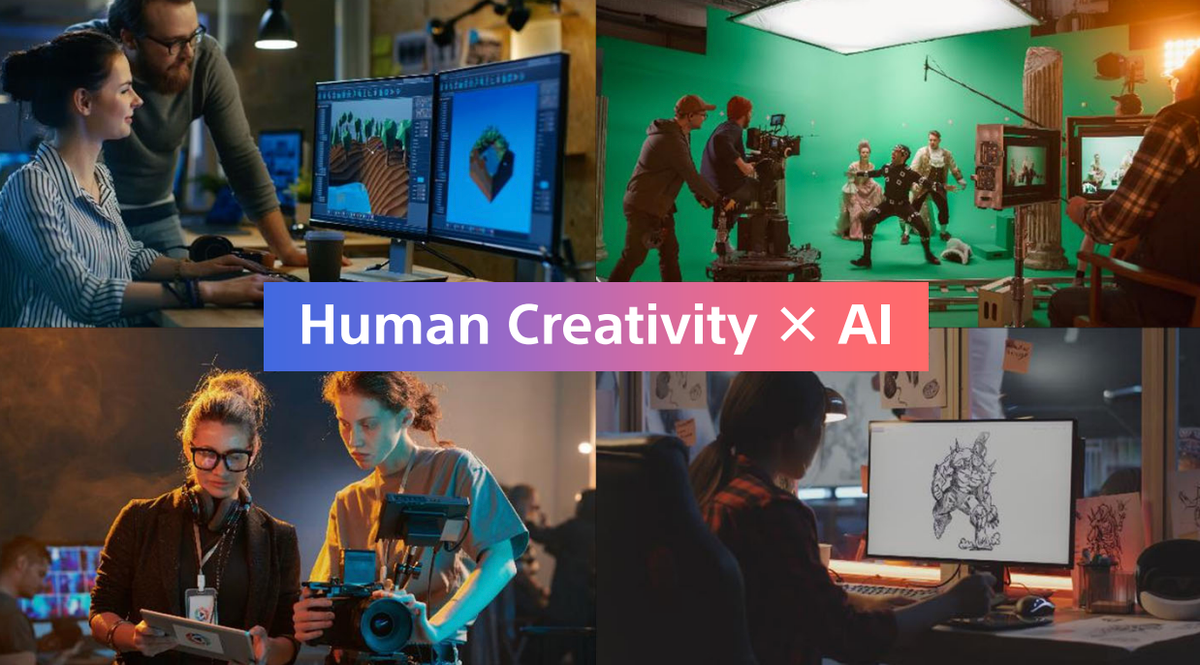
Sony's AI strategy is not a generative AI strategy. The company is bundling together several different forms of AI — generative AI, reinforcement learning, animation automation, machine-learning upscaling, recommender systems and commerce optimisation — under a single corporate argument.
It believes that AI should amplify human creativity, accelerate production and strengthen Sony's entertainment platforms without replacing artists or creators.
Sony's own framing is careful. AI is "not a replacement for artists or creators," but an "amplifier of human imagination," with memorable experiences still created by humans and enjoyed by people.
The clearest example of explicit generative AI is Sony's pilot with Bandai Namco. Sony says the project explores how "Generative AI and the latest technologies" can contribute to realising a creator's vision in video production.
Crucially, the language is not about letting AI generate content at scale. It is about fixing the known weaknesses of generative AI: consistency, controllability, style accuracy and safe deployment. Sony says it is using multiple AI models, fine-tuning and proprietary data to generate output in an intended style with the accuracy and cost needed for production. That is the important distinction: Sony is interested in controlled generative AI inside managed creative pipelines, not open-ended slop generation.
At PlayStation, much of the AI strategy is not generative AI at all. Tools such as Mockingbird are better understood as production automation. Mockingbird quickly animates 3D facial models from performance-capture data, turning work that Sony says once took hours into something completed in a fraction of a second.
It has been adopted by teams including Naughty Dog and San Diego Studio, and used in released titles such as Horizon Zero Dawn Remastered. Sony stresses this does not replace human performers; it optimises the processing of live-capture data.
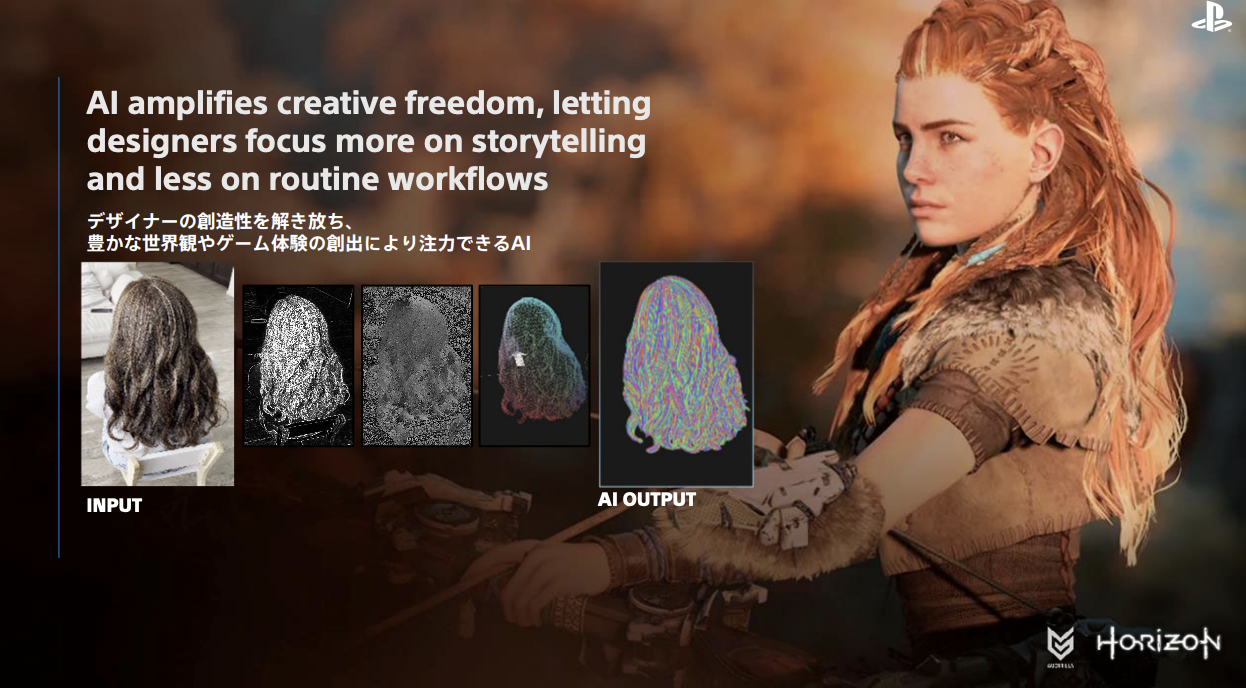
The same applies to Sony's AI hair-animation tool. This may be generative in a technical sense because it takes videos of real hairstyles and outputs 3D models with hundreds of strands, but Sony does not present it as generative AI. Strategically, it is about reducing high-friction production labour in triple-A development: facial animation, hair, QA, 3D modelling, animation and software workflows.
Then there is gameplay AI, represented by Gran Turismo Sophy. Sony describes GT Sophy as a superhuman racing agent trained through deep reinforcement learning to compete with top drivers and elevate gameplay. Sony also mentions prototypes where NPCs with their own personalities create more dynamic worlds, which may involve generative techniques, although Sony does not specify the underlying model type.
Sony's platform AI is different again. Over the past three years, it claims that AI-powered payment-routing tools have generated more than $700 million in incremental revenue. The company also says machine learning will improve recommendations and personalisation, helping players find games, gameplay moments, subscriptions, accessories and merchandise.
Finally, PSSR — PlayStation Spectral Super Resolution — is machine-learning upscaling, not generative AI. Available on PS5 Pro, it enhances image clarity and helps deliver 4K visuals at high frame rates.
The coherent read is Sony's AI strategy is to use generative AI selectively, where it can be controlled, while deploying broader AI and machine learning much more aggressively across production, gameplay, rendering, discovery and commerce.
This reinforces Sony's existing model: premium IP, high-fidelity production, trusted franchises and a tightly managed platform.
Read more here (pdf).