How AI is shaking up the Turkish game startup scene
Turkish game startups are drying up, while solo and duo AI-led teams are growing.

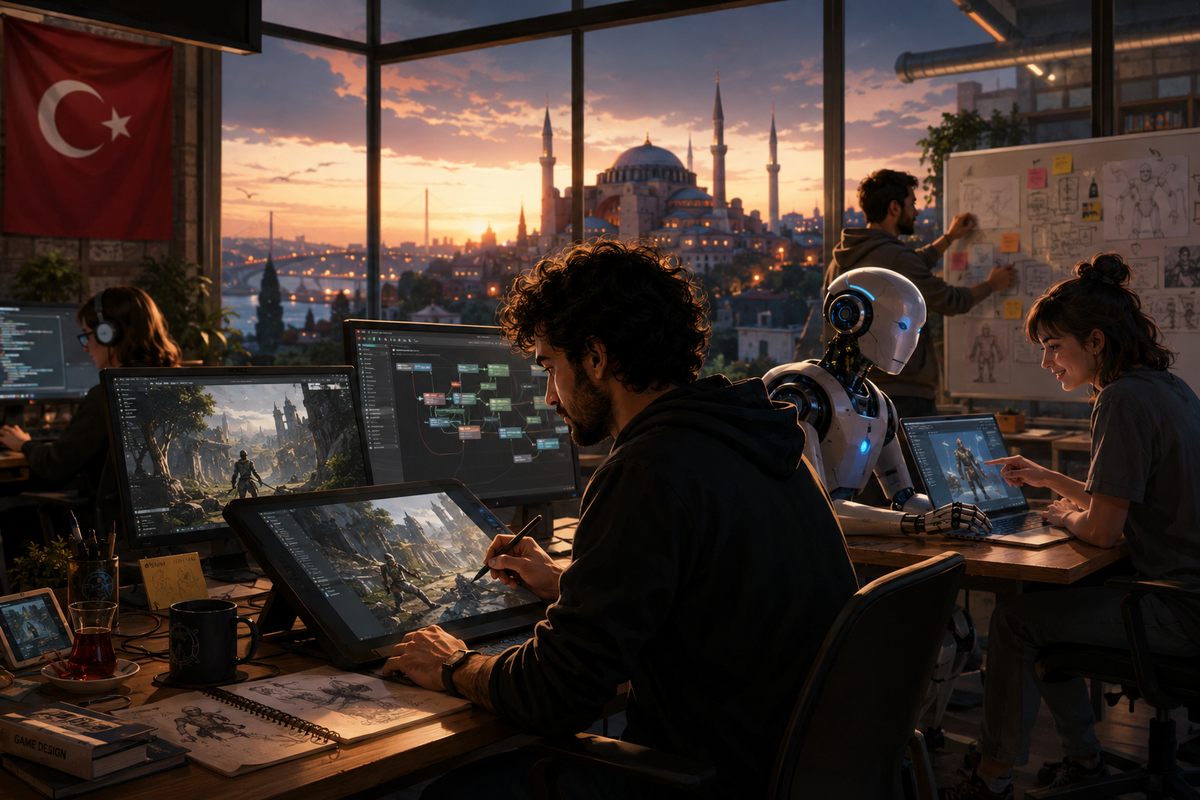
A report published by Rest of World describes a games industry restructuring visible in one country's numbers. Turkey's official studio formation rate has collapsed, junior hiring has largely stopped, and the count of one- and two-person teams shipping games has multiplied.
The reporting is anecdotal, but the figures around the anecdotes are specific enough to be worth examining.
Turkey was, until recently, the largest game development hub in Europe with more than 800 active studios. In 2021, over half the top ten mobile games on Apple's App Store came from Turkish developers. The country produced two unicorns in consecutive years: Peak in 2021, Dream Games in 2022.
Since then, new studio formation has fallen off a cliff. Rest of World reports roughly 200 new gaming startups in Turkey founded in 2021, 84 in 2023, and 30 in 2024 — an 85% decline from the peak across four years.
Over the same period, the number of very small teams shipping games rose sharply. Steam's first Turkey-focused event in 2023 drew 67 applications from studios with two or three employees. A year later, the same event drew 254.
Those two trends are usually reported as though they contradict each other. They do not. Fewer companies are being incorporated while more individuals are shipping products, which is what happens when the minimum viable team size for a commercial game falls below the threshold at which forming a company makes sense.
Rest of World's reporting puts names to both sides of that split. Ender Tınkır worked on Toon Blast at Peak, then on Royal Match and Royal Kingdom at Dream Games — three of the larger mobile hits to come out of Turkey. He went solo in 2022. His studio, Play On Studios, released its first mobile game, Zen Mahjong, earlier this year, built using Microsoft Copilot, OpenAI's Codex and Claude Cowork.
He told Rest of World he developed it in two months without doing the coding, design or product decisions himself. An investor has since approached him to start an AI-powered mobile game company; the new studio has two staff.
Emirhan Gül, 24, spent five months at an Istanbul startup working on the design of 23 games before burning out on the pace. He turned down an offer from a US firm and founded his own studio. He told Rest of World that Claude Code's launch in early 2025 meant he needed two full-time employees rather than the near-dozen at his previous job. He is the only developer on the team, and also handles game design, social media and investor meetings.
Begüm Ceren Onar, a game designer, was laid off from an Istanbul studio in December after a game her team had worked on for years failed commercially. She said the studio then decided to use AI to generate ideas for new products and laid off 17 of its 20 employees.
Güven Çatak, who runs the Game Lab at Bahçeşehir University, says junior positions for his students have collapsed, and that the route of joining a large studio, gaining experience and progressing to a senior role no longer exists. His colleague Nazım Adaklı, who lectures on AI in games at the same institution, describes a developer friend doing the work of five junior programmers alone with AI tools. Adaklı's advice to students is that this is the worst moment to enter the industry looking for a stable job and the best moment to start a venture.
However, the seniority profile of the successful solo developers is the detail worth considering.
Tınkır can ship a game in two months without writing code because he spent years shipping Toon Blast inside studios that taught him what a shippable mobile game looks like. Gül can run a studio on two people because he designed 23 games in five months first, badly and at speed, and learned something from it.
Both are operating AI tools with judgment acquired through exactly the junior-to-senior pipeline that both of them agree has now closed.