What DeepMind learns from EVE Online
Google DeepMind has partnered with EVE Online to build training environments for the next generation of AI agents.

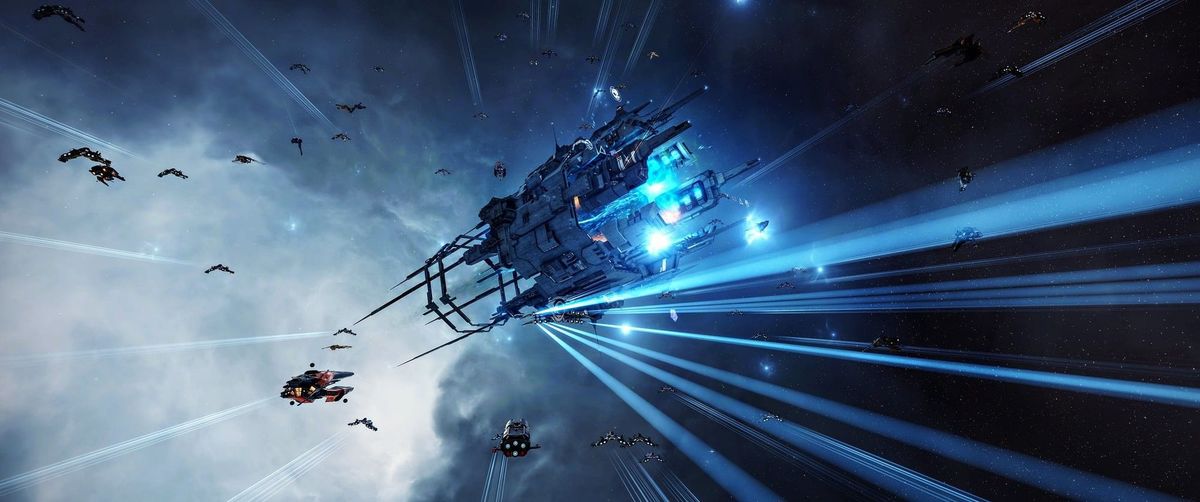
Google DeepMind’s partnership with Fenris Creations, the newly independent studio behind EVE Online, is not just another games industry AI deal. It is the continuation of a long-running DeepMind strategy to use games as controlled environments for training AI systems.
Of course, EVE Online is not StarCraft, and that's precisely the point.
DeepMind’s earlier work with games was built around clear competitive challenges. AlphaGo mastered Go. AlphaStar learned to play StarCraft II at a high level. These were extraordinary achievements because they required planning, pattern recognition, adaptation and strategic execution under pressure.
StarCraft, in particular, was useful because it added imperfect information, real-time decision-making and a huge range of possible actions. An AI could not simply calculate a perfect move. It had to scout, infer, react and manage limited resources while an opponent was trying to deceive and defeat it.
But StarCraft is a match, whereas EVE Online is a much messier and more interesting domain. EVE Online is a persistent world.
In StarCraft, every game resets. Players start from broadly equal positions, the goal is clear, and the outcome is binary: win or lose. In EVE, however, its economy, alliances, corporations, wars, reputations and territorial conflicts continue over months and years. Decisions have consequences. Assets are accumulated or destroyed. Trust is built or broken. Markets move. Groups adapt. History matters.
For DeepMind, that makes EVE a much more sophisticated training environment for the next generation of AI agents. The challenge is no longer merely whether an AI can beat a human in a bounded game. The question is whether an AI can operate intelligently inside a living, social, adversarial system.
It is a world where strategy is not just about battlefield tactics, but logistics, diplomacy, market positioning, intelligence gathering and social coordination. A sophisticated EVE player doesn't ask, “How do I win this fight?” They ask, “What should I build, who should I trust, where should I move capital, which risks are hidden, and how will this decision affect my position three months from now?”
And that is why the partnership is significant. EVE Online offers DeepMind a rare combination of long-horizon planning, incomplete information, economic simulation and multi-agent behaviour.
These are much closer to the problems that frontier AI systems will need to solve in the real world.
The offline nature of the collaboration is also important. DeepMind is not simply dropping experimental agents into EVE’s Tranquility live server and letting them run wild. Fenris Creations has said the research will use a controlled offline version of the game. That gives DeepMind the ability to run experiments, reset conditions, simulate different scenarios and test how agents behave without disrupting the live player economy. In effect, its version of EVE is a synthetic society in a box.
This also explains why EVE Online is more useful than many other games. A shooter can test reflexes. A strategy game can test tactics. A sandbox can test navigation and instruction-following. But EVE tests persistence, incentives and institutional behavior. It contains trade, scarcity, destruction, coalition formation, espionage, territorial conflict and player-created governance. That makes it much closer to a complex economic system than a conventional video game level.
For Fenris, the benefit is also obvious. The newly independent studio gains prestige, capital and a relationship with one of the world’s most important AI labs. Longer term, the technology could feed back into EVE itself with smarter NPCs, better onboarding, dynamic missions, economic tools, AI copilots or entirely new forms of agentic gameplay.
StarCraft taught DeepMind how to train agents to win. EVE Online may teach them how to survive, adapt, trade, remember, cooperate, betray and plan inside a persistent world.
That is a much harder problem. It's also a more valuable win.