Why gamers hate AI
Do gamers want better games or purer games?

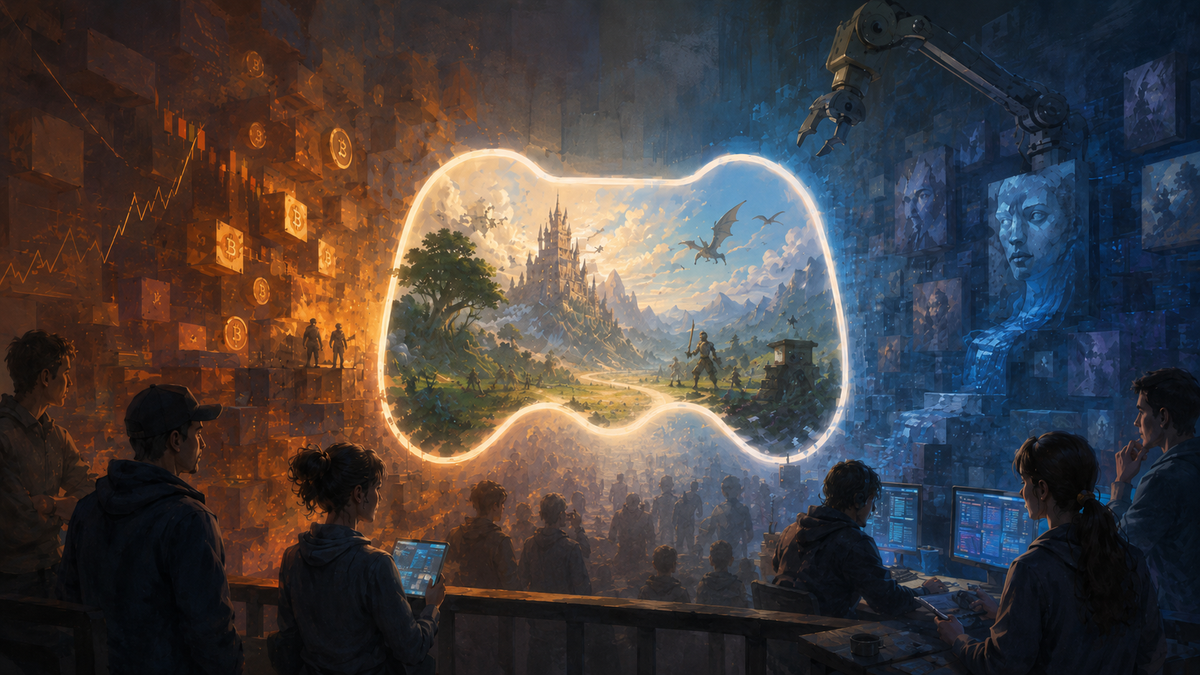
The mistake is to think the backlash against new technology in games is about the technology itself.
When players reject blockchain, they are not rejecting distributed databases, tokens, NFTs, or new payment rails. When developers reject generative AI, they are not rejecting faster concept art, synthetic voices, procedural dialogue or automated code assistance.
In both cases, the issue is how the technology threatens the status that games have recently acquired, providing credentials for gamers across politics, labor, gender and identity.
This is the shift. Games are no longer treated as disposable entertainment software. They are cultural artefacts. They are social spaces, aesthetic statements and political battlegrounds. They carry the same burdens previously attached to literature, music and film, but perhaps more so because they are interactive.
Questions of authorship, exploitation, authenticity, representation, class and gender have all migrated into games because games are now sophisticated and culturally visible enough to carry the weight.
Gamergate did not make games political. It revealed that games had already become culturally serious enough to fight over. Before that, arguments about games were framed as being internal to the experience — their difficulty, their graphics, their narrative, and their economic value.
Afterwards, however, games became a proxy for who had the right to define the medium. Were games primarily a hobby built around play, or were they a serious cultural space requiring interrogation through the lens of gender, labor, capital and political legitimacy?
That question has never gone away. Blockchain triggered one version of it. AI is triggering another.
The argument against NFTs in games was presented as concern over scams, speculation, ugly JPEGs, bad implementations, environmental damage and the financialization of fun. Some of that criticism was justified.
But the vehemence of the rejection came from somewhere deeper. Blockchain threatened to make explicit the economic machinery that games had previously been hiding. Players were already buying billions of dollars of skins, battle passes, loot boxes, currencies and virtual goods. Even core PC gamers. How else did Gabe Newell get his $500 million yacht?
Games had been marketplaces for years, but they had maintained just enough mystique to pretend they were not. The magic circle remained intact because the financial systems were largely controlled by trusted incumbents, wrapped in polished interfaces and framed as consumption rather than speculation.
Yet, somehow, everyone still hated EA. NFTs crystalized that toxicity, particularly because the companies pushing the model were often insurgent startups rather than established platform holders. The wrong people were making the money too. The fact that Filipinos and Vietnamese players were suddenly being discussed as economic winners did not make the Western core-gamer class any more comfortable.
AI produces a similar but sharper reaction.
For, where blockchain threatened to financialize play, AI threatens to industrialize the culture.
That is why AI is not being judged simply as a production tool. It is being condemned as a force that threatens to unbundle the meaning attached to game creation. If a game’s art, writing, animation, voice acting, localisation, quests or NPC dialogue are generated by machines, is the game still culturally legitimate? Does it still carry the evidence of human craft? Can it still count as art in the way some players and critics want games to count as art?
For a significant portion of commentators, players and developers, the answer is no. This is not always because the output is bad. The deeper objection is moral. AI breaks a logic that has become attached to serious cultural production. This is that meaningful work should remain visibly connected to human labor, human intention and human authorship.
This is where the politics enters the picture. The angriest anti-AI argument in games is broadly left-coded. Capital is using technology to absorb human craft, reduce labor costs, weaken creative workers and turn culture into an extractable data product. Art styles become inputs. Voices become models. Writing becomes training material. Workers become costs to be optimised away.
It’s why so much attention is placed on whether game developers can unionize, whether outsourcing workers have been properly credited, whether voice actors have consented to synthetic replication, and whether artists’ work has been scraped into models without permission.
Half-baked neo-Marxism, for sure. But the underlying critique — that capital is using technology to separate value from labour — fits easily into wider anxieties about AI. It gives the backlash a moral vocabulary.
Still, it would be wrong to say all anti-AI sentiment comes from that tradition. The coalition is broader.
Some of it is conservative. This is a gut reaction, a defence of craft and the dignity of made things, even virtual things. Some of it is aesthetic. Some of it is professional anxiety, which cuts across ideology entirely. Artists, writers, actors, designers and programmers are not irrational to worry that tools sold for productivity may become mechanisms of replacement.
But this sort of attitude also contains a contradiction.
- Players want abundance. They want vast worlds, constant updates, fully voiced quests, smarter NPCs, richer localization, more reactive stories, faster patches and cheaper games.
- Developers want tools that reduce drudgery, automate repetitive work and allow smaller teams to make more ambitious projects.
- Publishers want efficiency because modern game production has become grotesquely expensive and structurally risky.
AI promises all of this. It promises scale, speed and responsiveness. It may enable forms of interactive entertainment that were previously impossible. AI promises precisely the kind of abundance players keep demanding.
Yet the same audience also wants artisanal legitimacy. It wants industrial output with the aura of handcraft. Small batch goblins, if you will.
It wants games that are enormous, polished and constantly updated, but also morally legible as the product of fairly treated human creators. It wants technological progress when that progress expands play, but not when it appears to flatten culture into content.
And this is the central tension.
Games became culturally serious, but they did so as industrial products. That was always unstable. A blockbuster game is not a poem written in isolation. It is software built by hundreds or thousands of people through pipelines, tools, outsourcing networks, middleware, engines, contractors, monetization teams and platform constraints.
The rejection of new technology in games is therefore not anti-technology in any simple sense. Gamers are intensely technological. They obsess over engines, graphics cards, frame rates, physics systems, modding tools, online infrastructure and platform features. The resistance is triggered when technology threatens the cultural status of the medium.
Blockchain did that by making games look like financial systems. AI does it by making games look like humanless content flows.
Both offend the emerging sensibility that games should be more than products. Once that expectation exists, the conditions of production matter. The artefact is no longer judged only by whether it is fun. It is judged by what kind of environment produced it.
The real tension is that, unlike blockchain, the backlash will not stop AI.
The economic pressure is too strong, the tools too useful and the creative possibilities too large for every actor within games production. Nor does that mean that all AI use is culturally corrosive. There is a profound difference between replacing an artist and giving an artist a sharper instrument; between laundering a copied art style and enabling a small team to prototype impossible ideas; between flooding a store with slop and building systems that allow richer forms of play.
But the argument will remain charged because it is not really about technology. It is about legitimacy.
Games spent decades before being taken seriously. The cost now is that every major technological shift is no longer assessed only as a feature upgrade. It is assessed as a cultural threat.
That’s why AI in games is such an explosive issue. It exposes the unresolved question beneath the medium’s new status.
Is a game primarily a playable system, judged by what it allows the player to do? Or is it a cultural artefact whose meaning depends on the human labour, politics and authorship behind it?
The industry wants the first answer when it needs freedom to innovate. The culture increasingly insists on the second when it suspects innovation is being used as extraction.
Neither side is going away. That is the problem, and the story. Games are no longer just games. But nobody agrees what they have become.