Why Tencent's AI World-Builder Hy3D WorldClaw relies on Claude
Tencent Hunyuan's agentic 3D open-world generator turns text into game-ready terrain and assets.

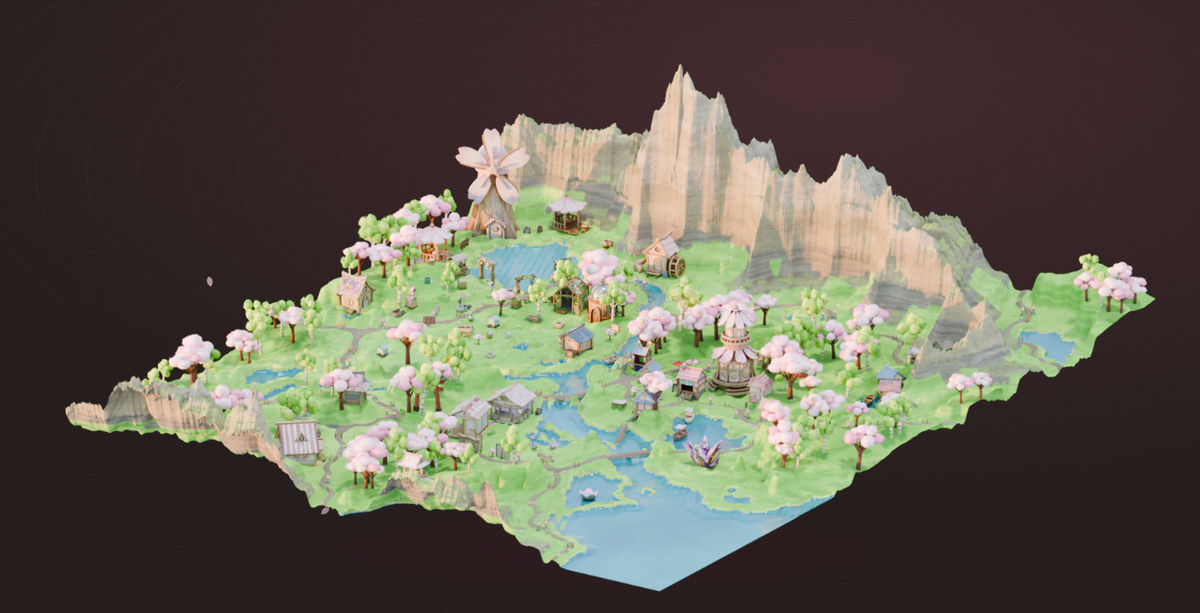
WorldClaw is a research system from Tencent Hunyuan that turns a text prompt into a large, freely walkable 3D open world made of real, editable meshes, not a video or a fixed-viewpoint Gaussian-splat scene.
It works coarse-to-fine. Planning agents convert the prompt into a structured spec: regions, terrain, materials, spatial relationships, etc. The system then builds a globally coherent terrain foundation across the whole map. Detail-dense regions are individually generated, placed, and reconstructed as editable 3D objects, and a final render-inspect-refine loop catches mistakes such as objects clipping into terrain or being the wrong scale.
So far, so AI. What's interesting about the underlying structure, however, is that one orchestrating agent — in this case Claude Opus 4.8 — coordinates a stack of specialist tools as callable skills.
GPT-Image-2 is used for layout and asset imagery; SAM3/SAM3D for segmentation and 3D reconstruction; Hunyuan3D for generating and refining objects; and Blender (via BlenderMCP) as the execution environment where scenes are actually assembled and rendered.
State passes between stages as structured specs and rendered images. Claude plans; tools execute. Claude inspects the render, decides what's wrong, and issues corrections. It's a loop, not a single forward pass, a technique we've previously seen in Gauntlet Loops.
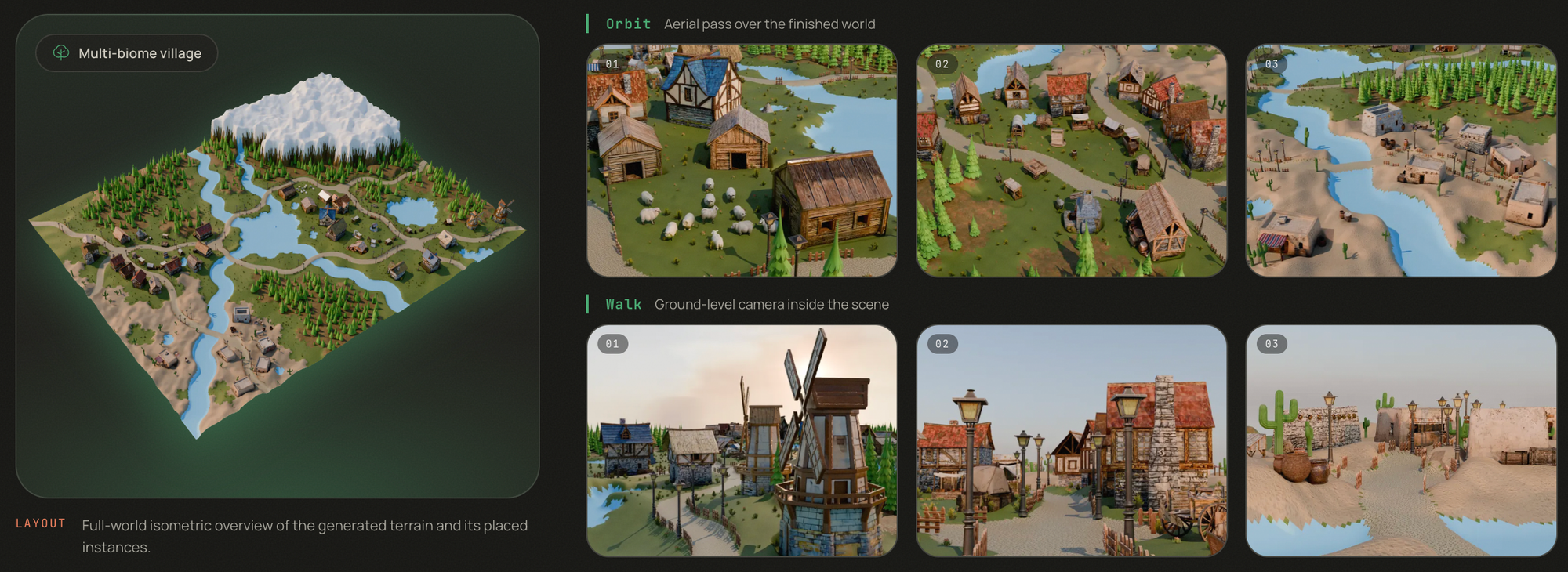
All of this is detailed in the new research paper WorldClaw: Agentic 3D Open-World Generation at Scale, which also explains Claude was used because "current open-source language models often struggled to generate procedural terrain and materials that were both executable and consistent with user requirements".
Reading between the lines, the demanding part of this job is writing correct, executable Blender Python code across many iterative rounds, driven by a structured spec, in which a subtly wrong script silently produces broken geometry rather than throwing an obvious error.
That's a harder bar than most coding benchmarks test. Long-horizon, tool-calling-heavy, low-tolerance-for-drift agentic coding is precisely where frontier closed models have kept an edge even as open weights close the gap elsewhere.
Sadly, the paper doesn't give any operational data. There are no token counts, no per-scene generation time, no dollar figure. The only infrastructure detail is that experiments ran "on a server equipped with 4 NVIDIA H20 GPUs" — nothing you can turn into a cost estimate.
Standard Claude Opus 4.8 API pricing runs $5 per million input tokens and $25 per million output tokens (cached-input reads drop to $0.50/M). A multi-stage pipeline like this will burn millions of tokens per scene once every agent turn and tool round-trip is counted.
As a loose anchor, a comparable complex agentic coding task (a full library rewrite) recently ran to roughly 11 million tokens for about $43. WorldClaw's pipeline has more stages and tool calls than that, so a plausible guess is a single open-world scene lands somewhere in the double-digit-to-low-hundreds of dollars in API spend. In comparison, games generated through Gauntlet Loops can cost anything from $360 to $865.
As for where the project goes next, it's important to note there's no code release or no timeline. As well as costs, neither do we know the latency of the refinement loops or the frequency at which complex Blender node graphs collapse to crude approximations when generated code fails.
Nevertheless, the concept attacks one of the most labor-intensive parts of open-world production, such as building a coherent large-scale 3D terrain and populating it with placed, editable assets. This is work that currently takes environment art teams months to complete, which means the paper's citing of future Unreal Engine integration would be a very welcome addition.