AI slop will kill games, but grow ecosystems
AI will kill off many game companies but it will allow many game communities to flourish.

If the games market is suffering from anything, it's suffering from too many high-quality games. Players have never had cheaper, better things to play, and that's the issue for the games industry.
The old hope was that a good enough game could break through. Better graphics, better production values, a bigger license, a stronger marketing campaign, a smarter monetization system: all of these were treated as routes to a hit.
But the games market is no longer a contest between new products. It is a contest between new games and already-loved experiences that players have inhabited for years.
That's a hard problem. Players are not waiting for the next release. They are too busy in existing games through friends, routines, skill, status, inventories, spending, identity and shared memory. A new game is not just asking someone to try something different. It is asking them to reduce their commitment to existing social and emotional networks.
This used to be most obvious in MMORPGs, where guilds, raids, servers and characters created visible lock-in. Now it applies much more widely. Fortnite, Roblox, Minecraft, EA Sports FC, Call of Duty, Counter-Strike, League of Legends, Valorant and Genshin Impact are not products. They are places, habits and social containers. Their strength lies not just in content, but in continuity.
That changes the economics of launching games. The real scarcity is not content, but collective attention. A single player may be curious about a new release and add it to their Steam Wishlist. The more difficult question is whether a whole friend group, guild, Discord, school cohort or creator audience moves at the same time. Without that simultaneous migration, many games are sampled, praised and then quietly abandoned as players drift back to where their people already are.
Covid made this situation worse, but it did not create it. During the pandemic, engagement surged, funding was cheap and companies extrapolated temporary growth far into the future. Studios over-hired, publishers over-invested and investors over-believed. When behavior normalized, the industry was left with too much of everything – headcount, content and projects – except players' discretionary time and money.
This is why artificial intelligence is not going to rescue the games market for most companies. It is more likely to intensify the problem.
AI is useful. It can speed up prototyping, code, localization, marketing, customer support, testing, asset iteration, documentation and live operations. It can make small teams more productive and large teams more efficient. But the central problem in games is no longer producing content. It is the difficulty of getting players to move.
AI therefore attacks the wrong side of the equation. It increases the amount of game content that can be produced, but it does not increase the amount of time players have. It does not dissolve their existing friend groups. It does not erase years of progress, identity, skill and costs sunk inside the games they already play.
In a market already struggling with oversupply, cheaper production may make the noise louder. More games, more prototypes, more live-service attempts, more Steam launches, more mobile tests and more content drops will compete for the same finite attention. AI reduces production friction in a market where adoption friction is now the harder constraint.
But that does not mean AI is irrelevant. It means the benefits will be unevenly distributed.
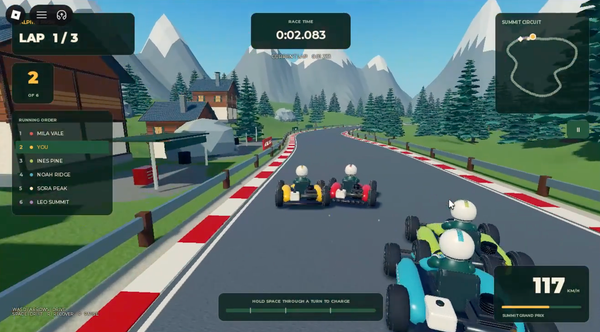
AI is much more powerful for platforms that already have players. Roblox is the clearest example. AI does not need to help Roblox create one perfect game. It only needs to help millions of creators make more usable content inside a social environment where players already spend time. The same logic applies to Fortnite/UEFN, Minecraft-like ecosystems and other platforms that combine creation tools, identity, social graphs, recommendation systems and monetization.
For these companies, AI strengthens the existing model. It generates more novelty without requiring players to migrate elsewhere. The social container remains the same, while the content inside it changes faster. That makes existing platforms more sticky.
The same logic also points toward a wider opening up of games. The most interesting opportunity is not just AI-generated content made by studios, but AI-assisted content made by users. Games that expose APIs, data layers, modding systems, MCPs and other programmable interfaces allow players and third-party creators to build around them.
They become worlds that can be extended, not just products that are consumed.
This is not new. Some of the most durable games already benefited from being surrounded by player and developer tooling.
- EVE Online had a deep ecosystem of market tools, killboards and corporation management systems.
- World of Warcraft’s add-on culture allowed players to reshape the interface and the way they organized play.
- Destiny generated an ecosystem of inventory managers, item databases and progression trackers.
- Minecraft became a platform for servers, mods, plugins and custom rulesets.
- Fortnite and Roblox have gone further by turning creation itself into a core part of the product.
AI changes the scale and accessibility of that behavior. Previously, these surrounding tools mostly required technical users, specialist communities or dedicated third-party developers. MCPs and AI-assisted creation lower that barrier. They allow more users to query, modify, automate and build around game worlds without needing to be full-time software developers.
This is also why some blockchain games are relevant despite the wider weakness of crypto gaming. Games such as MapleStory Universe and EVE Frontier have been developed natively to give players the same permissions as developers when it comes to creating tools, dashboards, agents, side games, competitions, markets and social rituals around the core world.
The important point there isn't the presence of tokens. It is the idea of the game as a programmable environment that contain computer-native payment networks.
And this is where AI may give new projects a chance. Not by allowing them to out-content the incumbents, but by helping them serve passionate, specific, high-agency communities that want to build, modify, extend and participate.
These projects may not immediately become mass-market platforms. They may start smaller, deeper and more niche. But if their users can create meaningful activity around them, they have a different route to relevance.
So AI does not reverse the games market’s oversupply problem. For most companies, it makes it worse. But it does strengthen embedded platforms and open programmable worlds.
The winners will be the companies that understand AI not merely as a way to make more content, but as a way to empower users to create more value inside worlds they already care about.