Why AI gaming will reward social networks, not engines
2026 has seen engine companies rebuilding for AI. But engines are becoming irrelevant.


Simon Willison published four games last week, built with no more than four hours of his own work each. A spot-the-difference game about trees. A fifteen-minute fantasy RPG whose ending moved him. A pumpkin farming simulator. And a Command & Conquer-style real-time strategy game with two-to-four-player multiplayer, seven maps, replays, medals and a random map generator.
Not one of them touched a game engine. All four are HTML and JavaScript using three.js, running in a browser, hosted statically on GitHub Pages or Cloudflare Pages.
That is a problem for a specific set of companies, and a considerable opportunity for a different set, and the month's announcements look different once you sort them by which group they fall into.
Willison's argument is that October 2026 is to vibe-coded games what November 2025 was to coding agents: a threshold crossing.
His specific claim is that Claude Opus 5.5 got good at the thing the industry insisted could not be automated, which is game design rather than game production. He prompted a mediocre RTS with "make it a LOT more fun" and says it worked. He also notes GPT-6 Astra isn't there yet, so this is a claim about one model rather than the frontier, and his evidence is four hobby projects he chose to show, with fun measured entirely by his own enjoyment.
Take it as directional rather than proven and the structural consequence still holds. For a large band of games, the engine is no longer the thing anybody picks.
Unity's entire position rests on the opposite. When it shipped its first-party Claude Code plugin in September, its director of AI products explained the reasoning: developers increasingly begin by describing a game to a coding agent rather than downloading an engine, and the agent picks the engine for them, so the plugin exists to ensure the agent picks Unity. Epic's Tim Sweeney reached a similar conclusion from the other direction, saying the aim was to survive the AI revolution.
Both are arguments about winning a selection event. But Willison's experience suggests that for browser-scale games the selection event doesn't occur. Frontier models already know three.js and Phaser, modern mobile browsers are more than capable, and nothing in the loop asks which engine to use.
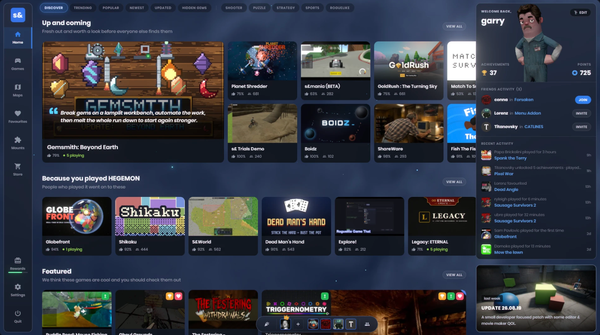
Which means the contested layer has moved. If production costs approach nothing, the bottleneck is the thing it always becomes under abundance: getting anyone to play the thing. Garry Newman put it plainly a fortnight ago when he abandoned the Netflix-for-games model behind S&box — you cannot land people on a menu of sixty games and tell them to have fun, because people find games through recommendations, through streamers, and through multiplayer sessions already in progress.
All three of those are other people. The scarce asset is a social graph.
The cleanest demonstration is in Willison's own post, though he doesn't frame it this way. His four games sit on static hosting with no discovery mechanism of any kind. They reached an audience because Simon Willison has a newsletter. Production solved, distribution entirely personal.
On that basis, Discord is the best structural fit, and by some distance. Its Activities are web apps running in an iframe through the Embedded App SDK, which is precisely the format Willison's games already exist in — a vibe-coded three.js game is a Discord Activity in all but packaging.
Discord has opened Activities to all developers to build, launch, distribute, discover and monetize natively, with discovery through its App Launcher. The pitch is friends already sitting together in a voice channel, which is Newman's "active multiplayer games" delivered rather than approximated.
And it is the only platform in this category with a published number. Discord's reported platform fee is 30%, dropping to 15% on the first $1 million in gross sales per developer. Compare that with the alternatives. Google gates Playground creation behind a Google One subscription tier and has disclosed no creator revenue share at all. Meta promised in-game monetization and a Horizon Creator Fund with details to follow. Newman's answer was to make S&box free. Pantaloon charges $5 per month to an audience in the tens of thousands. Discord is the only one that can tell a creator what they would earn.
Meta has the opposite profile: the largest social graph on earth, native publishing into Facebook and Instagram feeds, creator following already functioning — and a waitlist, no availability date, and no stated terms for anybody getting paid. On raw reach it is unmatched. On everything else it is a promise.
Roblox is the interesting one, and more complicated than it first appears. It moved earlier than most: its September developer conference brought prompt-based creation called Build, currently in public alpha in New Zealand and expanding to Serbia and Singapore, alongside Assistant and Code Assist for Luau. Roblox Studio now ships its own MCP server, letting any external AI client read and edit a place directly — which is the same maneuver Unity made with its plugin, arrived at independently.
But Roblox games are Roblox games, written in Luau on Roblox's engine. Its cross-platform announcement concerns Roblox content reaching the web, not web content reaching Roblox. So it is not positioned to absorb this wave so much as to compete with it, capturing creation inside its own walls and betting that models become as fluent in Luau as they already are in three.js.
The party most exposed is Google, which is not the conclusion three weeks of coverage would suggest. It launched Playground on 7th October with discovery through an Explore gallery surfaced by player ratings and activity. That is a menu with a sorting algorithm, and Newman declared the menu dead eight days later. Google's structural weakness has always been social. Play Games profiles with creator following is a graph it must construct rather than one it holds. It has the models, the compute, the engine partner in Unity Spark, and no room full of friends to put any of it in.
Xbox sits between them. Asha Sharma's LABS memo named the boundary between creation and play as one of three assumptions deserving to be challenged, and measures success by whether more people are playing and creating. Xbox has Play Games profiles and an installed base, but its social layer is not where gaming conversation actually lives, which is the thing Discord has owned for a decade.
And Steam, which handles roughly 30,000 releases a year, at about 80 a day, is a storefront rather than a graph. Reviews, friends lists and curators are real, but the shape is a catalog, which is exactly the shape Newman says fails.
For most of 2026 the fight was over which engine agents would reach for, and Unity, Epic and Capcom all repositioned around that question at some cost. The answer arriving now is that for a large and rapidly growing class of games, agents don't reach for an engine at all. They write JavaScript, and the result needs somewhere to be played with other people.
Which makes the valuable thing not the tool that builds the game, nor the catalog that lists it, but the room it opens into.