'No AI' as a distribution strategy
Pantaloon's monthly subscription Playbill program bans generative AI games.

When anybody can make a game, nobody needs help making games. They need help choosing games.
This means the filter, not the catalog, becomes crucial, and the cheapest, most legible filter available is a promise not to use AI.
And so indie game publisher Pantaloon (Bluesky not X) has launched a subscription service called Playbill. It's a curated collection of what founder Jamin Smith calls "bold and bizarre" indie games that don't use genAI in any form.
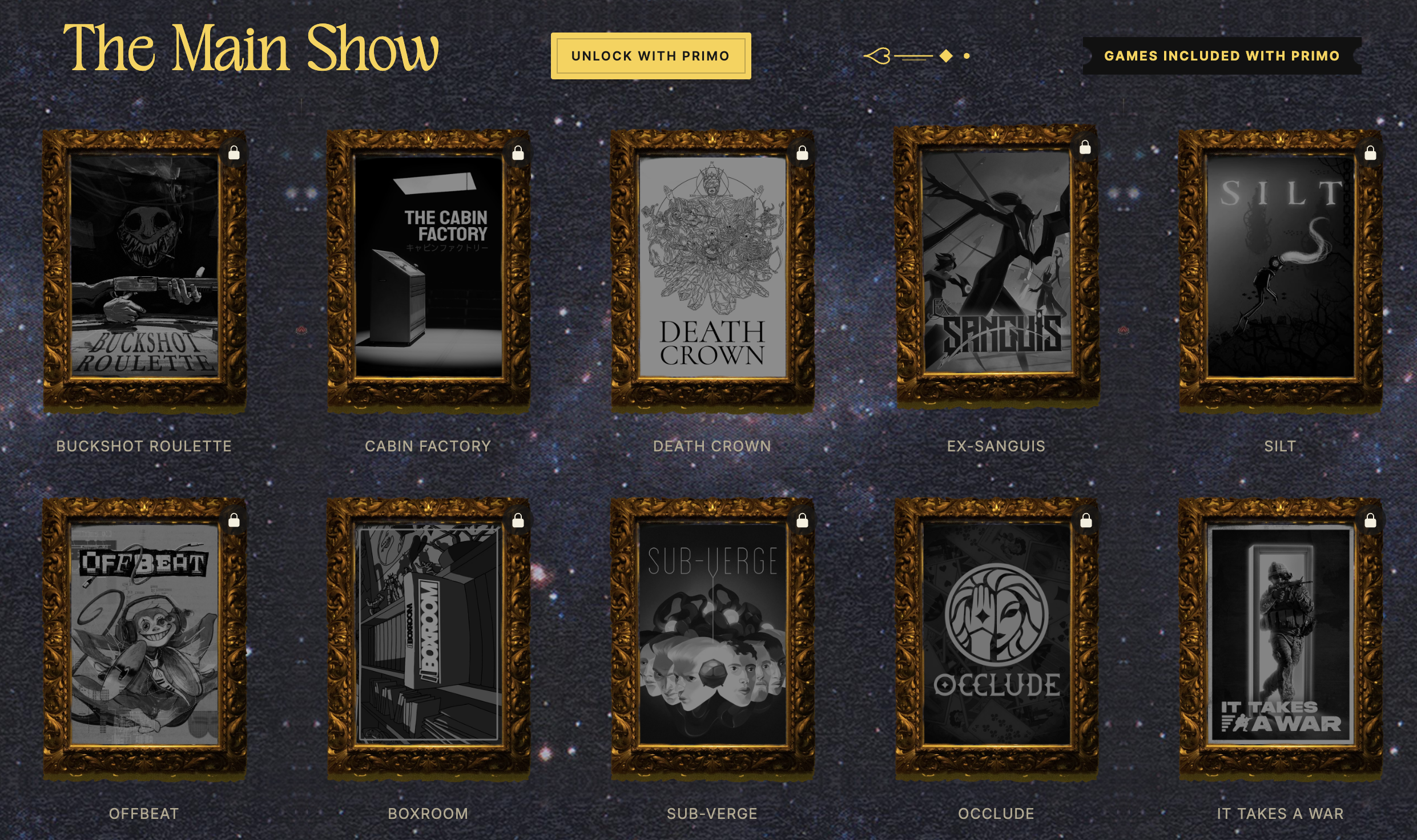
There will be thirteen titles at launch, including third-party work such as Buckshot Roulette, Silt, Ex Sanguis and Cabin Factory, alongside Pantaloon's own Sub-Verge, Occlude, It Takes a War, Boxroom, Rolla and the music creation sim Offbeat. There is a timed exclusive in Virtue: Prologue, and a section called the Green Room that features demos, playtests, and abandoned prototypes. It costs $5 a month or $60 a year.
Consider the market it's launching into.
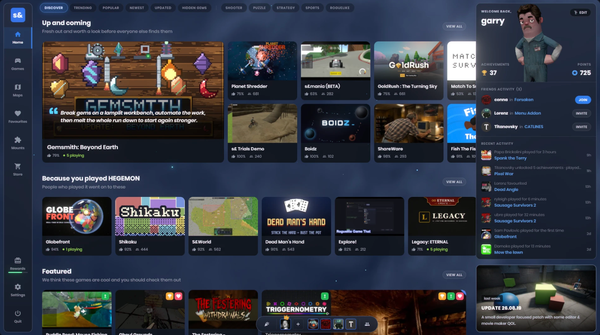
Steam will see something like 30,000 releases this year, roughly 80 a day. Around a third of them are expected to carry AI content disclosures, more than 7,000 titles. Similarly, Garry Newman's S&box, the spiritual successor to Garry's Mod, filled up with low-quality AI-generated games almost immediately after release, and Newman has since conceded that the flood made surfacing anything good much, much harder.
Abundance is no longer the constraint. Attention is. Brad Wardell of Stardock made the point bluntly earlier this month. What finished off triple-A was not AI but digital distribution, because you are now competing against every game ever made, and human beings can only hold so many things in mind at once. AI simply accelerated a problem that was already structural.
So, abundance is the problem, which means the most defensive option is to make scarcity the product, which is exactly what Pantaloon's design manufactures.
Smith's own framing is explicitly oppositional. The model lowers the barrier for players to try genres and experiences that Steam's market-shaping algorithms would not surface. That is a direct bet against algorithmic discovery, placed eight days after Newman published the post-mortem arguing the same thing — that the goal should not be the platform with the most games, but the one with the best.
The mechanics are more novel than the positioning, though, and they are worth highlighting.
Playbill is key-based. Pantaloon holds a finite stock of Steam keys for each game and cycles titles out when these run dry. That is a different economic animal from Game Pass. Developers are paid per key rather than per hour played, which sidesteps the engagement-payout problem that makes subscription deals unappealing to small studios, and it requires no per-title revenue-share negotiation. It is capital-light. It also cannot scale — which is a feature if scarcity is what you are selling, and a hard ceiling if it isn't.
Retention is also designed in rather than bolted on. Monthly subscribers receive one game a month and cannot choose which. Full access to the library unlocks only after six consecutive months. Smith is candid that this exists to stop somebody collecting everything and canceling. But annual subscribers get the lot immediately.
Then there is the price, which is remarkable mainly because it exists. Google gates Playground's creation tiers behind a Google One subscription and has disclosed no creator revenue share at all. Meta promised in-game monetization and a Horizon Creator Fund with details to follow. Newman's answer was to make S&box free. Three of the largest companies on the planet launched creation platforms this quarter and the only operator who can tell you how the money works is an indie publisher that grew out of a newsletter.
That origin is not incidental either. Pantaloon built an audience of more than 50,000 newsletter subscribers who solved puzzles to earn game keys, then became a publisher, then launched a subscription. Audience first, platform second, which is the inverse of everybody else and precisely the sequence Newman identified as the one that works.
So the no-AI commitment is best understood as the sharpest available signal to a specific audience, in a market where signals are scarce and catalogs are not.
It is a certification play, and certification markets are what emerge whenever abundance makes verification valuable. Organic produce, fair trade, dolphin-safe, no palm oil. None of those labels describe a superior product in any absolute sense. They describe a filter the buyer has decided to trust, hence trust is the thing being sold.
Which is also where the vulnerability sits, because every certification market eventually meets the same problem. Playbill's guarantee rests on developers self-reporting in a market where self-reporting is known to understate by roughly half.
For a distribution strategy, though, enforceability may matter less than legibility. The ban's job is to be understood instantly by the people it is addressed to, and it does that perfectly.
It works on day one, costs nothing to implement, and differentiates immediately from every platform betting the other way. The exposure is that it is a single-point failure: one title found to have used AI, and the proposition the subscription rests on is critically damaged.
And this also makes the experiment worth watching. In a market producing 80 games a day, can a credible promise about what's not in the box make a business more defensible than one about what is?