Can Roblox Reality really deliver structured logic and photo realism?
Roblox has announced Roblox Reality, which hopes to leverage Video World Models and edge data centers to deliver narrative-driven, photorealistic masterpieces.

David Baszucki has never been shy about big visions. Roblox's CEO has spent two decades building a platform where tens of millions of people create and play together, and his latest ambition is characteristically sweeping.
"We believe the ultimate architecture for gaming — and the holodeck — is Roblox Reality," he wrote, invoking Star Trek's fictional immersive simulation with the confidence of someone who thinks he can actually build it, (or wants to persuade investors he can!).
It's a bold claim. But for the first time, Roblox has published enough technical detail to evaluate whether it might be more than a dream.
The Problem With World Models
The starting point for understanding Roblox Reality is understanding what it isn't. Following the success of Large Language Models, the next challenge in AI are World Models; that is models which natively understand the 3D world as LLMs handle text, images and audio.
In the case of Roblox Reality, the technology it's leveraging is Video World Models. These systems, which are trained on vast quantities of video data, can generate photorealistic, interactive environments in real time. They are, as Baszucki puts it, "essentially real-time dreams."
And that's precisely the problem. Dreams are not games. A dream has no rules that persist between sessions. It has Nno shared state that two players can inhabit simultaneously. There's no physics engine that guarantees the same ball lands in the same place every time. Pure World Models are spectacular at generating pixels but terrible at maintaining the structured logic that makes a game a game. They hallucinate. They forget. They cannot be trusted to remember that you built a wall here and won the match there.
Traditional game engines, meanwhile, face the opposite constraint. They are extraordinarily good at persistence, logic, and multiplayer synchronisation, but achieving photorealistic visuals demands years of development and hundreds of millions of dollars. The gap between what a three-person indie team can build and what a triple-A studio ships has, if anything, widened in recent years.
Roblox's bet is that you can simultaneously solve both problems by combining the two approaches.
The Hybrid Architecture
The technical architecture behind Roblox Reality, outlined in a detailed post by SVP of Engineering Anupam Singh, divides the problem into two distinct layers.
The Roblox Engine and Roblox Cloud own what Singh calls the "data model" — the persistent world state, simulation logic, gameplay mechanics, multiplayer synchronisation, and server authority that keeps a shared experience coherent. This is the structured ground truth: the score, the physics, who shot whom and when.
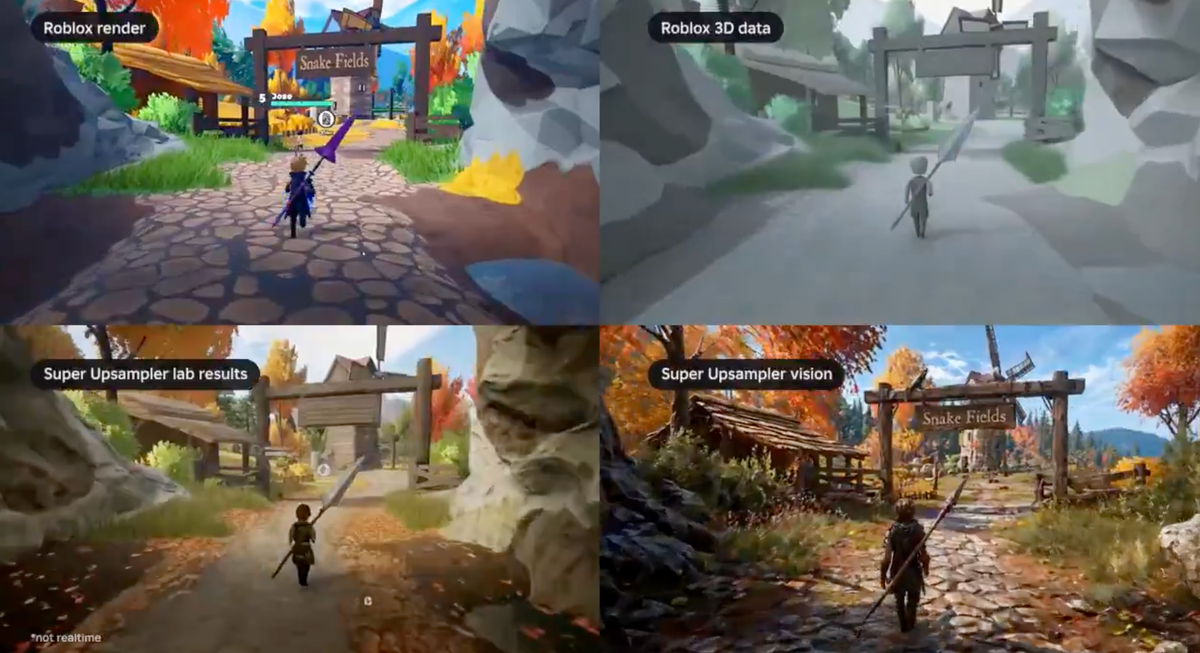
On top of that foundation sits a Video World Model acting as what Baszucki calls a "Super Upsampler." Rather than generating the game itself, the model's job is to generate pixels, layering photorealistic visual detail onto the underlying simulation. Weather systems, particle effects, texture richness, environmental atmosphere: the kinds of secondary visual elements that eat enormous amounts of traditional development time but don't affect gameplay integrity if the AI occasionally gets them slightly wrong.
The elegance of the split is that it plays to each system's strengths. The engine handles everything that needs to be correct and consistent. The model handles everything that needs to look extraordinary. As Baszucki frames it: "The Roblox Engine provides the underlying synchronised ground truth while our video model acts as a Super Upsampler to layer on photorealistic detail."
Why this could actually work
The architecture is more coherent than it might initially appear. By restricting the World Model to visual upsampling rather than game logic, Roblox sidesteps the hallucination problem that makes pure World Models unsuitable for games. If the AI generates a slightly odd cloud formation or an imperfect fire effect, nobody cares — the gameplay beneath it is still governed by deterministic engine rules. The system degrades gracefully.
Crucially, Roblox already has the infrastructure to build on. The company operates 26-plus edge data centres worldwide, capable of running millions of game instances at peak loads exceeding 45 million concurrent users. That existing footprint matters enormously: the plan for Roblox Reality is to deploy H200 and B200-class GPUs in adjacent edge facilities rather than building from scratch. Roblox became cash flow positive in recent quarters and has been reinvesting heavily in its platform. This is a company with both the financial standing and existing infrastructure network to absorb what is still a significant hardware bet.
H200 and B200 GPUs list at $30,000 up to $50,000 per unit respectively. Delivering real-time photorealistic upsampling even at modest concurrent user counts requires meaningful GPU density per edge node, and the blog is candid that "given the high compute cost, we realise there are challenges we need to solve before we can scale the Roblox Reality architecture." That honesty is welcome, even if the specifics remain unquantified. The question isn't whether Roblox can afford the pilot. It's whether the per-session economics work at the scale of tens of millions of daily users.
The open questions
The creator angle is where Baszucki's vision becomes most commercially interesting. The promise is that this architecture will "remove barriers to high-fidelity creation, allowing a team of three people to build a narrative-driven, photorealistic masterpiece in a single week."
The mechanism is straightforward: developers no longer need to hand-author photorealistic assets because the World Model generates the visual layer dynamically. The structural work — designing levels, writing scripts, building game logic — remains human. The pixel-pushing becomes the AI's problem.
The timeline for testing that promise is "later this year or early next" for an early access version targeting 2K resolution at 60 frames per second. That's a specific performance target set well in advance of availability, and the gap between architectural announcement and shipping product has a way of expanding. Whether Roblox hits those numbers will be the first real signal of whether the economics are under control.
And then there is the cultural question that no architecture diagram can resolve. Roblox's extraordinary strength is its creator community; millions of developers, many of them teenagers, building in Lua with tools they've spent years mastering. This hybrid architecture implies a fundamentally different creative workflow. Whether that community embraces the transition or resists it will matter as much as the technology itself.
Baszucki's closer is characteristically cinematic: "This is an early look at turning solitary AI dreams into a social, playable reality." The direction is right. The infrastructure foundation is real.
The cost curve remains the challenge Roblox itself admits it hasn't solved, but for the first time, you can see the blueprint it thinks gets there.