LingBot-World 2.0: a live world you can play, but not a game
Robbyant's LingBot-World 2.0 claims an hour of stable, interactive generation from a single image.


Robbyant, the embodied-AI lab under Chinese corporate Ant Group, has recently released a six-model suite called LingBot 2.0, aimed at giving robots a hardware-agnostic "brain" for perception, planning, and action.
The model drawing outside attention is LingBot-World 2.0, also called LingBot-World-Infinity: a model that generates a fully interactive environment from a single image, then lets you move through it in real time at 720p and 60 frames per second, with the headline claim being an hour of continuous play without visible degradation.
Robbyant's own site describes it as "a live world you can play." That phrase is doing a lot of work, and it's worth separating what's genuinely new here from what the framing implies.
Let's start with the real technical claim because it holds up better than most AI demo headlines do.
The system splits into a director agent, a vision-language model that reasons about the current scene and proposes what should happen next, and a pilot agent, a diffusion transformer that grounds those proposals into actual frames.
The pilot is trained with a strict causal factorization, meaning each frame depends only on past frames and past actions, with a specific attention mechanism, called MoBA, designed to stop the model from over-relying on perfect accumulated context.
In post-training, a distillation step optimizes the model directly on its own long self-generated rollouts rather than on clean teacher-forced data, which matters because that's precisely the condition, self-generated context rather than ground truth, that causes most video world models to drift and collapse within seconds.
Robbyant names two prior causal models, MAGI-1 and Worldplay, as the comparison point, both of which degrade within seconds to a few minutes. If the hour-long claim holds, it's a real improvement over a known baseline.
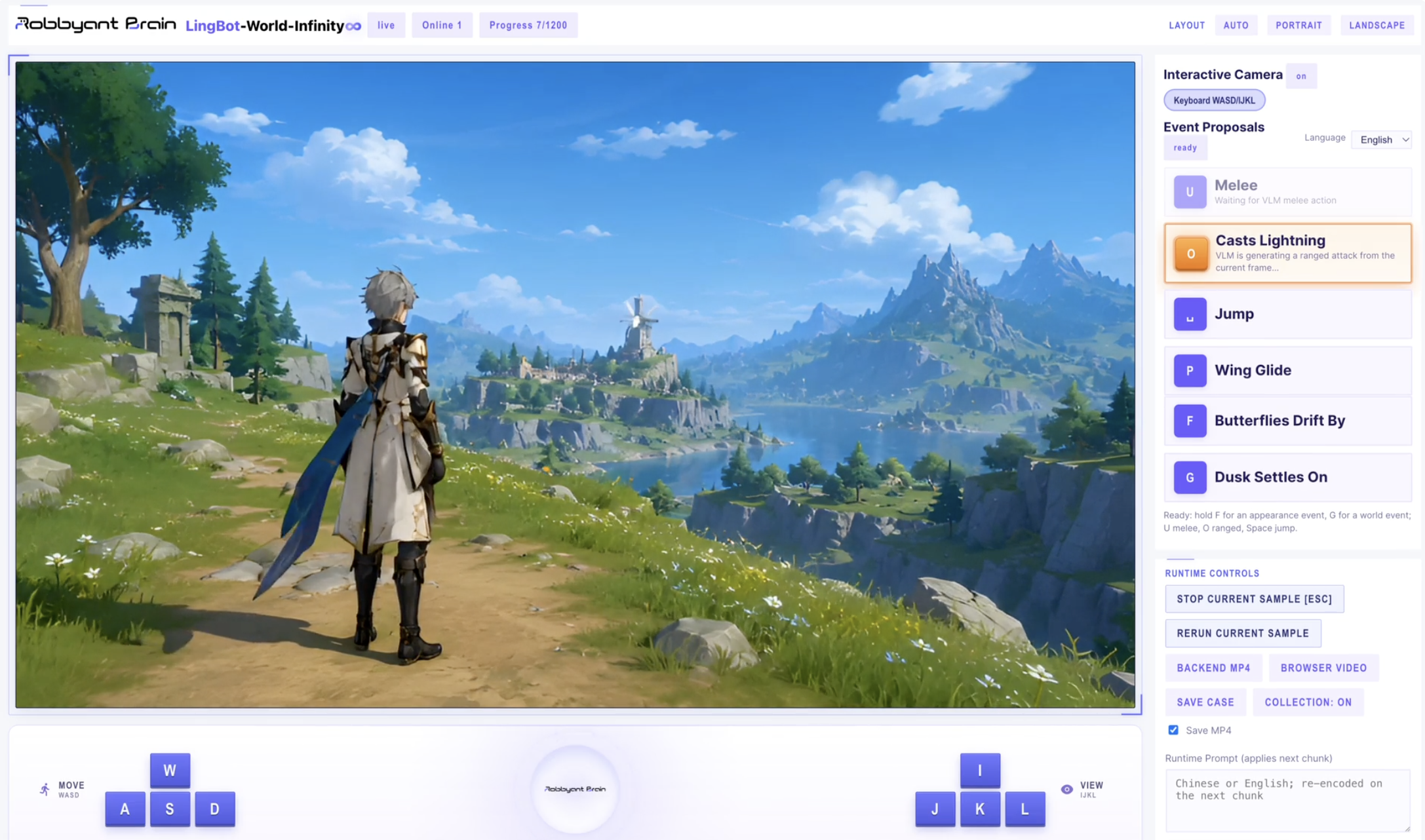
That's the part worth taking seriously. The part worth pushing back on is what "playable" and "persistent" are being asked to imply.
The website leans hard into game language: "Real-Time Exploration Of Infinite Worlds," "Persistent Worlds Over Extremely Long Horizons," and "Temporally Evolving Worlds."
What's absent from all of it is any actual game design. No quests, missions, objectives, scoring, win conditions, or progression appear anywhere on the page.
The closest thing to a multiplayer feature, "Collaborative Steering Of Shared Generative Worlds," turns out to be several users jointly shaping the environment itself, injecting events and steering what gets generated, rather than anything resembling cooperative or competitive play.
And the site is honest about where this is actually headed, in a section titled "From Playable Worlds To Embodied Simulation," which states plainly that the model "generalizes beyond game-like environments to support embodied simulation," serving as "a foundation for robotic simulation, future-state prediction, and interactive data generation."
Games are the demo. Robot training data is the product.
The more interesting catch is that the site's own marketing contradicts itself on the single claim doing the most rhetorical work. "Persistent Worlds Over Extremely Long Horizons" sits above a section called "Limitations And Next Steps," which states: "Several challenges remain, including true long-term world memory and extended interactions, and faithful physical understanding."
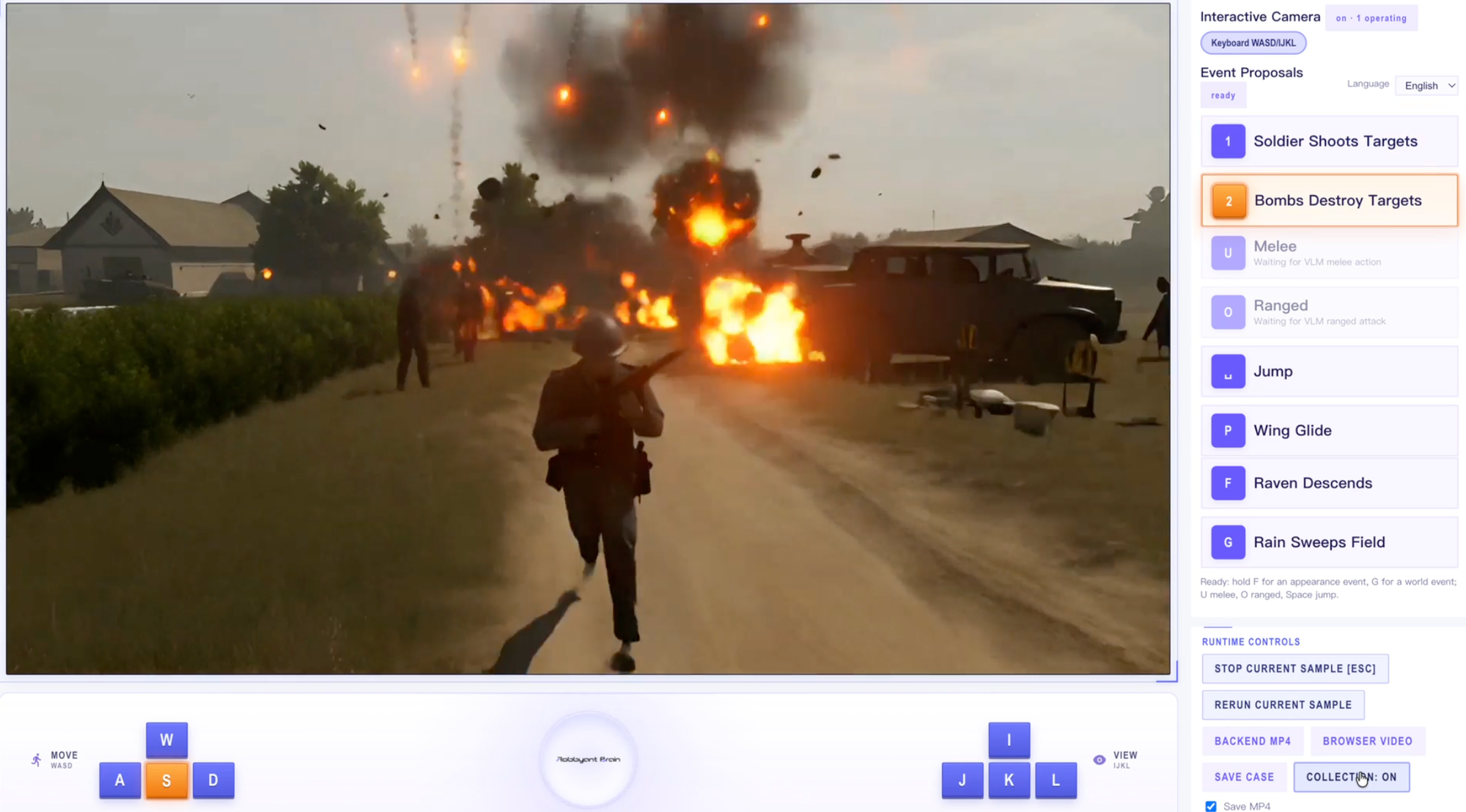
The accompanying technical report is more specific still: a region that leaves the model's rolling context window and is later revisited "tends to be regenerated rather than recalled."
That is not a persistent world in any meaningful sense. It's a model that doesn't visually degrade while you keep moving forward, and then quietly invents a plausible-but-different version of anywhere you go back to. Robbyant is calling that persistence in one headline and admitting it isn't in the next section down.
None of this makes the underlying research uninteresting. Causal factorization plus rollout-based distillation is a legitimate answer to a real problem in world modeling. An hour of stable generation against named baselines that fail in seconds is a genuine result worth tracking, especially for what it implies about training robots in cheap synthetic environments instead of expensive real-world data collection.
But it isn't evidence of AI building games, and it shouldn't be read that way. There's no persistent save state, no memory of what you did last time you were in a room, no rules, no goals, and no design intelligence of any kind, artificial or otherwise, deciding what makes an interaction meaningful rather than merely coherent.
What exists is a very good, very fast video generator that responds to input without falling apart, wrapped in the vocabulary of play because "a live world you can play" demos better at a robotics conference than "a training environment for embodied simulation policies".
Even though the second phrase is the more honest description of what Robbyant actually built and, per its own site, is still trying to get right.