Meta's demo-ing the TikTok of AI gaming
Pocket looks like a new app, but it's actually an old one with Meta's feed bolted on.

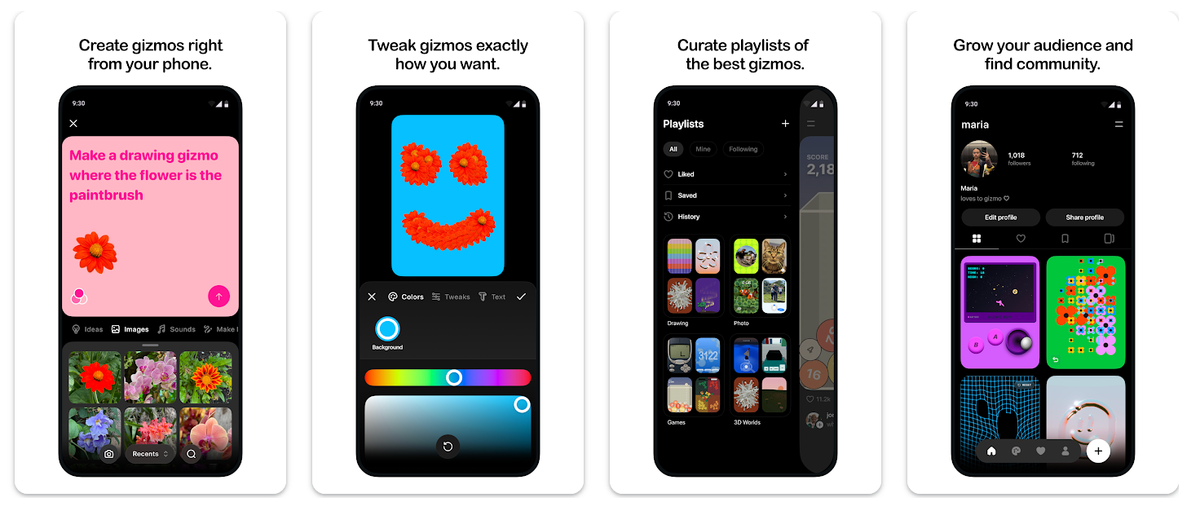
Meta has quietly launched Pocket, an app that lets anyone type a prompt — “a drawing gizmo where the flower is the paintbrush” — and get back a small, playable, touch-responsive game.
It appeared on iOS and Google Play on 29th June with no announcement, no press release. Strip away the branding, though, and Pocket isn’t really a new product. It’s Gizmo, wearing a Meta badge.
Gizmo is the creation of Atma Sciences Inc., a New York startup founded in 2024 by CEO Josh Siegel, CTO Daniel Amitay, and a small team that includes ex-Snapchat engineers. It raised roughly $5.48 million, built a genuinely well-liked product — 635,000 lifetime installs, 98% positive sentiment — and did the hard part: proving that prompt-to-playable mini-games are something ordinary users actually want to make.
Earlier this year, Meta hired that team into its Superintelligence Labs division. Crucially, this wasn’t an acquisition in the traditional sense — Meta didn’t buy Atma Sciences. It got a non-exclusive license to the underlying tech and put the people on payroll. Atma Sciences still exists.
Gizmo still exists, live right now at gizmo.party, completely unbranded by Meta. The two apps are running in parallel, which only makes sense if you read it as a deliberate market test: Meta comparing its own packaging against the original to see which converts and retains better before deciding how hard to push either one.
So what did Meta actually add?
It bolted on the part it’s actually good at: the feed. Pocket opens on a scrollable, TikTok-style discovery surface of other people’s gizmos, with likes, comments, shares, and a remix mechanic that lets anyone take someone else’s creation and reshape it into their own post.
Meta’s own documentation notes that remixed content can keep circulating “on, across and off Meta Products” even after the original is deleted — a detail that tells you the company is thinking about this less as a game-maker and more as a content-distribution engine.
Of course, this is the familiar Meta playbook: license or absorb the technical breakthrough, then apply the one asset almost nobody else can replicate — a feed, a graph, a distribution machine tuned over a decade to keep people scrolling.
Interactions with gizmos, per Meta’s own privacy language, also feed back into training Meta’s AI systems, so even a niche experimental app is doing double duty as data collection.
Whether “AI games as short-form social content” is actually a category people want remains genuinely unproven. Meta hasn’t committed to anything beyond calling it experimental.
But the structure of the bet is clear: don’t build the generative engine from scratch, rent it from the team that already nailed it, then pour Meta’s real competitive advantage on top and see if it catches fire.