Roblox completes AI acqui-hire hat trick with Morpheus AI deal
Roblox continues its ambitious path to build AI games running at 4K and 60 fps with its third acqui-hire in recent months.

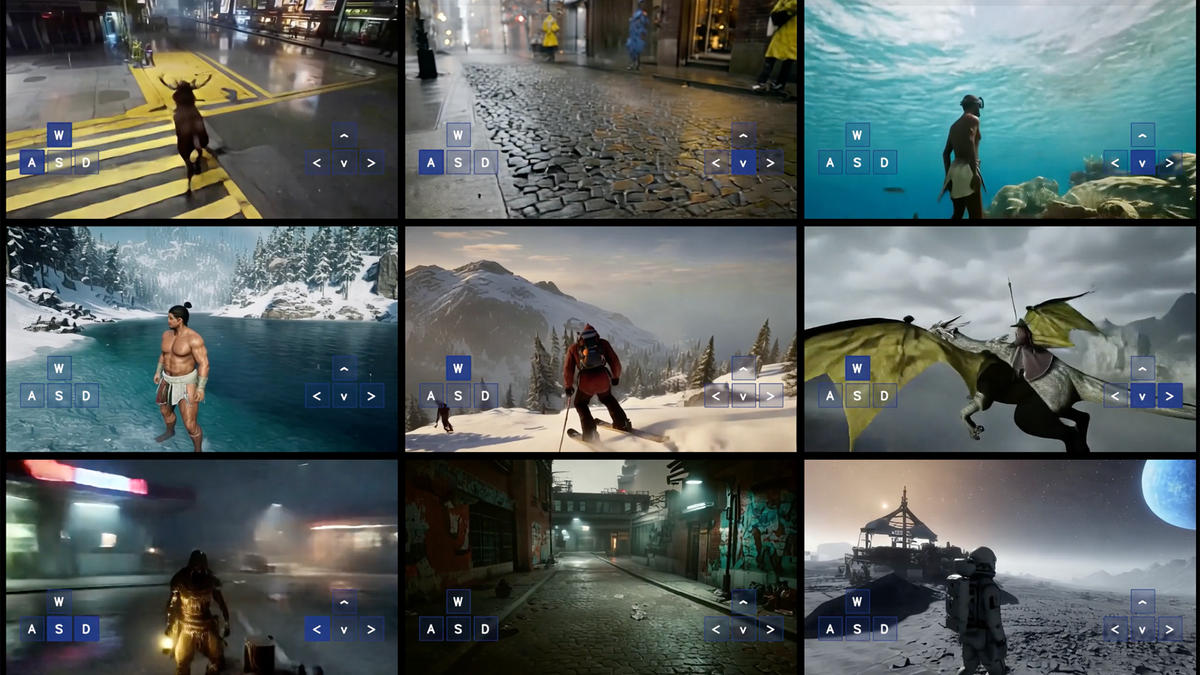
Roblox has made its third acquisition in the race to build photorealistic, AI-generated game worlds, bringing in Xun Huang and his Morpheus AI team to accelerate what it calls its “reality vision.”
Huang joins Joe Chen of Dynamics Lab and Alberto Hojel of Lucid AI, both of whom were acquired in late 2025, completing a trio of acqui-hires that collectively represent a concentrated bet on real-time generative video and interactive world models.
The target: AI-generated realities running at 4K resolution and 60 frames per second.
Huang’s contribution is perhaps the most technically striking. As the inventor of Self Forcing, a technique that converts offline video models into fast, autoregressive interactive generation engines, his work addresses one of the fundamental bottlenecks in AI-driven worlds: latency.
Turning what was previously a batch rendering process into something responsive enough for real-time play is a non-trivial leap, and it’s the kind of foundational research that separates demo-reel AI from something players can actually inhabit.
Chen, who joined from Dynamics Lab, focused on building real-time, general-domain generative world engines — the capacity to create interactive environments from uploaded images with text-prompt customization. Think of it as the bridge between a creator’s vision and a playable space: upload a photo, describe what you want, and get a functioning world back. For a platform built on democratising game creation, this is the logical next frontier.
Hojel’s Lucid AI, also acquired in late 2025, tackles what may be the hardest problem of all: consistency. AI-generated visuals are impressive in isolation, but games demand deterministic logic, physics that behave the same way every time, rules that hold across sessions, state that synchronises across players.
His invention of the Roblox game cartridge harness, which augments video world models with structured game engine logic, is an elegant approach to marrying the fidelity of generative AI with the reliability players expect.
Anupam Singh, Roblox’s SVP of Engineering, framed the challenge plainly: “The path to true interactive AI will have to address three major hurdles: latency, consistency, and quality.” Each acquisition maps neatly onto one of those pillars.
In this manner, Roblox is positioning itself not just as a platform for playing games but as the infrastructure layer for AI-generated interactive experiences. The combination of video world models for visual generation with the existing Roblox Engine for logic and state synchronization could, if it works, make Roblox the default environment where generative AI meets multiplayer gameplay.
There are open questions, of course. Real-time AI generation at scale remains computationally expensive, and the gap between controlled demos and millions of concurrent users is vast. Deploying the Roblox Video Model (Super Upsampler) to adjacent edge data centers powered by H200/B200-class GPUs will cost billions of dollars.
But Roblox has the distribution, the liquidity and now it has the research talent to push those boundaries.