Rocket League is now playable via AI-generated stream
MIRA is a neural network that's been trained on Rocket League and supports a four player gameplay via generative AI.

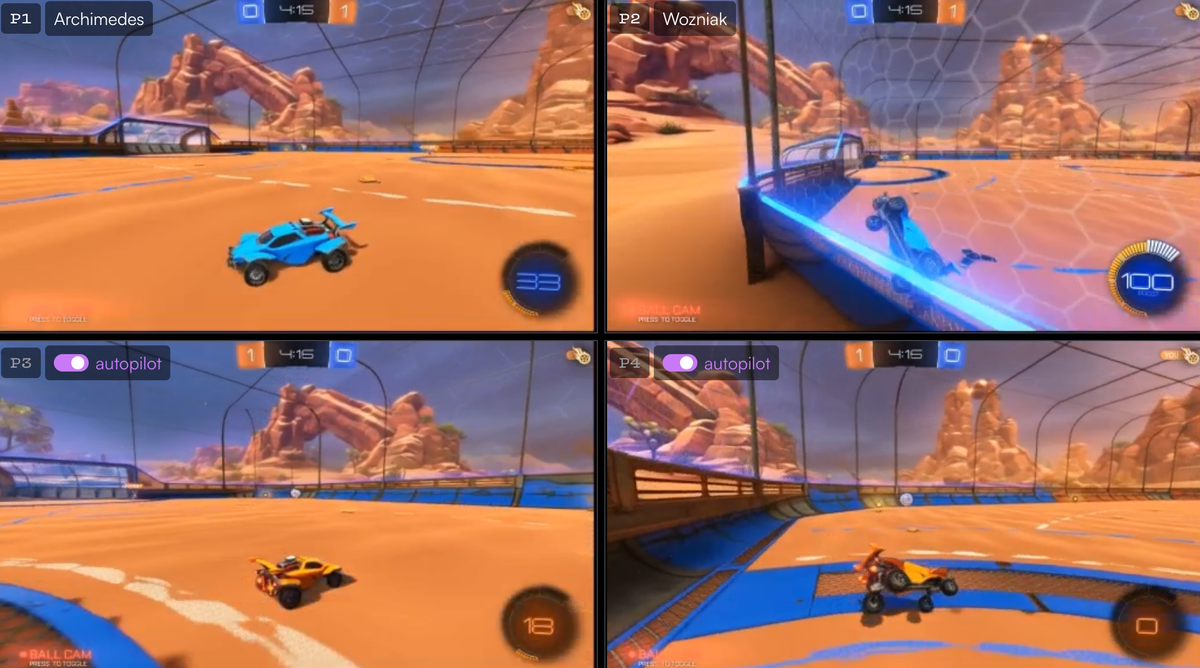
MIRA is a multiplayer world model developed by General Intuition, Kyutai Labs and Epic Games that generates a human-playable 2v2 Rocket League simulation directly from a neural network.
This means it doesn't use a physics engine or renderer. Instead, it takes action inputs from up to four players and outputs a single synchronized, physically coherent video stream frame by frame, with each player controlling a single quadrant.
What makes it impressive is that MIRA is not merely producing video that looks like Rocket League. It is generating an interactive, multi-agent simulation in which four players can act simultaneously and see a shared world respond consistently.
Technically, MIRA consists of two main components: a 600 million parameter video representation codec and a 5 billion parameter diffusion transformer. The codec compresses raw frames into compact latents. The transformer predicts future latents from past latents and player actions, using diffusion forcing in latent space.
The training data consists of roughly 10,000 hours of 2v2 Rocket League gameplay, generated entirely by the Nexto bot. No humans involved. Each match produces four synchronized first-person recordings, one per player, paired with that player’s action stream.
Training footage is standardized to 288p at 20fps and split into four-second chunks. This defines the training clip length; inference then proceeds autoregressively through a rolling latent context window.
A public dataset, Rocket Science, was released alongside the model, containing 4,000 hours of 720p player-view footage. For the multiplayer model, all four views and action streams are tiled together into a single input, so a single forward pass produces a jointly consistent world rather than four independently generated views.
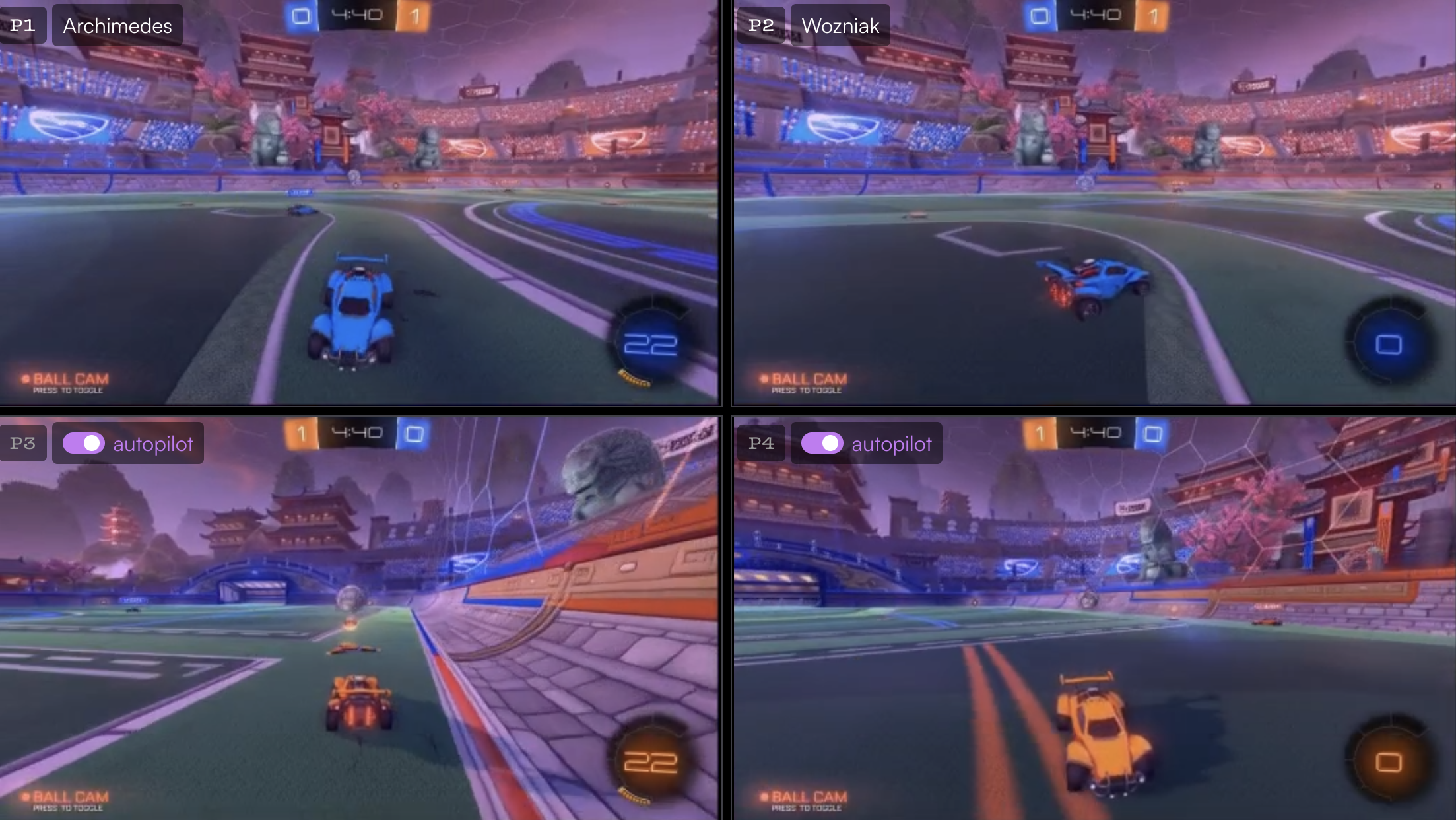
MIRA's temporal coherence is its key research finding.
The standard failure mode in autoregressive video generation is exposure bias. A model trained only on clean, real past frames has never seen the small, compounding errors its own generations introduce once it starts feeding its output back in as context. Each rollout step nudges the sequence off the training distribution. The next prediction is conditioned on that imperfect state, its own error compounds further, and the sequence eventually diverges.
MIRA’s fix is to intentionally add noise to past frames during training. The model is shown noised versions of prior latents and trained to keep predicting sensibly through that noise. This reduces the train/inference mismatch, because at inference time the model’s self-generated latents function as noise relative to ground truth. The model has already learned to treat that condition as normal input, rather than as an out-of-distribution signal that causes collapse.
The stated result is unusually long stability. The creators say that, “as far as we can tell,” MIRA can run indefinitely without diverging, and they demonstrate four autopilots playing continuous matches with no resets between goals.
The technical report says distributional quality is measured out to five minutes, while practical rollouts have been observed continuing for hours without collapse. The claim is therefore demonstrative rather than a fixed, benchmarked maximum duration.
Where divergence does occur, the DINO-based codec version exhibits a self-correction behavior not present in earlier versions. Rather than staying diverged, it can eventually snap back almost instantly. Stability is also distribution-dependent: it holds best in-distribution and degrades as the game state moves further from the training distribution of Nexto self-play.
The evaluation stack reflects the fact that no single metric verifies a playable simulation. FID checks visual fidelity, game-state probing tests whether physical dynamics can be recovered from generated footage, and action recoverability ratio checks whether player inputs have their intended causal effect.
This is why MIRA feels more significant than another impressive video-generation demo. The obvious comparison is not with Rocket League itself, which already exists as a highly optimized conventional game.
The more important comparison is with the idea of a simulator as hand-authored software. MIRA shows that, within a narrow but highly dynamic domain, a neural network can learn enough of the rules, visual structure, multiplayer state and causal action-response loop to become the game.
For world models, that is the key step. Most generative video systems remain cinematic: they produce plausible footage, but the user is not meaningfully inside the system, at least not for many minutes until its internal coherence breaks down.
MIRA is different because the footage is conditional, multi-agent and interactive. The model is not just predicting what Rocket League might look like next; it is responding to four streams of player input while maintaining a shared world across four viewpoints.
For gaming, the near-term significance is not that engines disappear. MIRA is too narrow, too expensive and too distribution-bound to replace conventional game development at the moment.
Its failures are precisely the sort of issues real games cannot tolerate. But it points to a new category of tool. Neural simulation layers trained from gameplay data will be useful for prototyping, AI agent training, content testing, or generating interactive spaces whose behavior is learned rather than explicitly programmed.
For, games already generate unusually clean training data for world models such as complete action logs, synchronized viewpoints, known physics state and unlimited synthetic play.
MIRA uses that advantage almost perfectly. It turns a game into a laboratory for learning interactive reality from pixels and actions, also providing an early glimpse of how AI may move from asset generation into the deeper layer of simulation itself.