The dividing line in games AI adoption is who can say no
Every games company is having to negotiate how it uses AI, but not every company has the same counterparties.

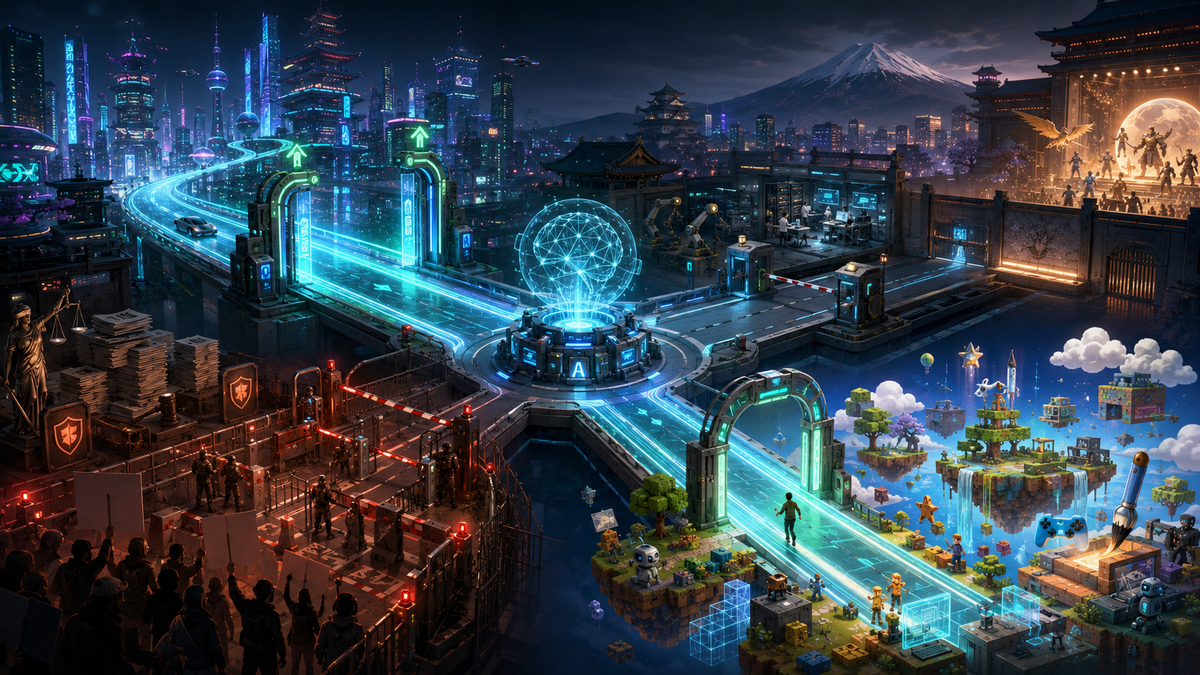
When it comes to AI, the games industry is sorting itself into two camps. But it isn’t east versus west. It isn’t big versus small either. Nor publisher versus developer. And it isn’t even PC versus mobile.
The jagged line runs between companies that face aggressive pushback and companies that don’t, or which are prepared to resist the pressure.
At the full-deployment end of the spectrum, miHoYo, the Chinese company behind Genshin Impact and Honkai: Star Rail, is planning to invest up to $14.6 billion to build internal AI infrastructure spanning GPU clusters, training systems, application frameworks and game-facing tools. The ambition is not AI as productivity software. It is to build a full AI stack for the company’s future games.
NetEase has pushed AI across its portfolio too, and in some ways it is a cleaner example because the work is already visible inside shipped or near-shipped games. Sword of Justice is the key case: NetEase describes it as an open-world wuxia MMO built around an adaptive AI NPC ecosystem powered by DeepSeek and its own proprietary AI system. Tens of thousands of NPCs are designed to have identities, memories and responsive behaviors, turning AI from a production aid into part of the social fabric of the game.
Nor is this limited to conversational NPCs. In Naraka: Bladepoint, NetEase has worked with Nvidia ACE on AI teammates that can join the player’s party, fight alongside them, hunt for loot, suggest skills and make tactical plays. The production side matters too. NetEase’s own AI Lab lists work across facial motion capture, video motion capture, speech-driven facial animation, auto-rigging, AI character creation, intelligent NPCs, matchmaking, anti-cheat, recommendation and live-ops systems.
And then there’s Tencent. At GDC 2026, it made the point numerically, arriving with a 20-plus-session program and a dedicated Tencent AI Summit focused on deployable AI technologies for 3D game development and production environments. Its sessions covered AI-assisted creation, scalable production, 3D generation, multi-agent scene layout reasoning, intent-driven scene editors, real-time speech AI and engineering solutions for large-scale content pipelines.
That matters because Tencent’s AI push is not just about putting a clever chatbot inside a game. It is about owning the model layer, the tooling layer and the production layer. Its VISVISE suite supports 3D animation generation, auto-rigging, auto-skinning, modeling, intelligent NPC systems and digital asset management. Its ASI World pipeline is positioned as end-to-end AI content production infrastructure. Its Hunyuan work pushes further into video, 3D and world generation, moving from generative assets toward the raw substrate from which future games may be built.
But it’s not just the Chinese giants. South Korean publisher Krafton belongs in the same broad camp. It’s committed $70 million to a dedicated GPU cluster and a further $21 million per year to internal AI tooling, with CEO Kim Chang-han reframing the entire company as “AI-first.”
These companies are treating generative AI the way they once treated cloud and mobile: as plumbing to industrialize.
It is also significant that, despite being global game companies, these are not the sort of entities against which western-style AI resistance easily organizes. There is no equivalent public pressure from a sector-wide games union movement in China or South Korea, no comparable copyright fight shaping every announcement, and no broad developer-sentiment backlash forcing executives to pre-apologize before they deploy the tools. The discourse is about implementation, not legitimacy. So these companies don’t hold back. They build.
But this isn’t the picture for all Asian powerhouses. In Japan, Sony and Capcom sound far more like cautious western publishers. Sony says AI will augment, not replace, its artists and creators. Capcom has taken a similarly careful public line: AI may help development, but AI-generated assets will not appear in final game content.
Capcom’s position is especially revealing because it separates production from production assets. On the player-facing surface, Capcom is protecting the craft of its franchises. It wants Monster Hunter and Resident Evil to remain authored, directed and recognizably human-made. But behind the scenes, the company is already using AI at serious operational scale.
Google Cloud says Capcom’s AI-assisted playtesting system runs more than 30,000 hours of autonomous testing every month. Its agents use visual inspection to look at the game screen in a human-like way, distinguishing an intentional design choice from a genuine graphical failure. Predictive agents analyze historical bug data to forecast where systems are most likely to break, then send autonomous test bots into those high-risk areas. Other agents turn veteran engineering knowledge into a searchable internal database, while data agents summarize technical logs so developers can act on problems faster.
That is not a small R&D demo. It is a production system. And it makes Capcom more interesting than a simple cautious Japanese example. The company is not rejecting AI. It is drawing a reputational border around it. No AI-generated content in the finished game; plenty of AI inside the machinery that makes the game shippable.
Square Enix is a similar example. In its medium-term business plan progress report, the company said it wants to automate 70% of QA and debugging tasks in game development by the end of 2027 through joint research with the University of Tokyo’s Matsuo-Iwasawa Laboratory.
Japanese publishers may be cautious around visible creative replacement — art, writing, voice, character and brand identity — but Capcom and Square Enix both become much more aggressive when AI is framed as invisible production efficiency. The resistance risk is lower when the audience does not directly see the substitution.
That also has to be understood inside Japan’s labor structure. Japan has legal protections for union activity, but it does not have a visible, game-industry-wide bargaining structure comparable to the emerging Western games labor movement, where QA departments unionizing is itself headline news.
The western picture is not uniform either. Roblox is the obvious counterexample to the idea that geography is destiny. Not only is it fully integrating AI within Roblox Creator tools, it is also pushing research that combines its existing game engine with video world models, using the engine for structure, persistence and multiplayer logic, and the world model for visual richness.
But as a UGC platform, Roblox can frame AI differently from a traditional publisher. It is not saying “we will replace our artists.” It is saying “we will empower our creators.” That gives Roblox a different political surface. More importantly, its core audience and creator culture are not the same as the toxic Steam audience, where anti-AI sentiment can harden quickly into a purity test. For Roblox, the same technology that might look like labor substitution at a triple-A studio can look like a way for kids and creators to make more things, faster.
Of course, the loudest abstention of all comes from the company with the most to lose from activist players. Take-Two CEO Strauss Zelnick has talked up Grand Theft Auto VI as a generational event while evangelizing the gospel that AI will not replace the human creativity behind Rockstar’s work. With this much expectation riding on a single title, anything that smells of AI slop is pure downside.
And that is the real variable: exposure to people who can impose costs.
The western developers most vocally opposed to generative AI — the ones who will put “no AI” on a store page as a marketing badge — are overwhelmingly operating where labor organizing is active and players are primed to punish slop.
GDC’s 2026 survey of more than 2,300 developers found a sharply negative view of generative AI’s impact on the industry. That sentiment has teeth: unionized studios, walkouts, and the SAG-AFTRA games strike over AI voice and likeness rights. Companies that depend on such a workforce and audience tread carefully because it only needs one stone to start the avalanche.
And yet there are a handful of companies successfully threading the needle.
The clearest western example is Embark Studios, which successfully launched extraction shooter ARC Raiders in late 2025. It put AI-assisted voice tooling into a live game but survived the controversy. The defense was that this was efficiency, not cost-cutting, and Embark later moved to re-record some AI lines with professional human actors. The lesson is that AI controversy can be survivable when the use case is narrow, the game is already loved, and the company moves quickly to legitimize the output.
However, it is notable that Embark is owned by South Korean outfit Nexon, whose CEO Junghun Lee has stated, “it’s important to assume every game company” is using the technology, adding that “AI has definitely improved efficiency in both game production and live service operations.”
In this manner, the less exposed parent company is taking a much stronger position than its Stockholm studio. Embark had to survive a western controversy: disclose, explain, stress that actors still matter, and adjust the output when the synthetic work weakened immersion. Nexon looks at the same company and sees the opposite lesson. ARC Raiders becomes proof that smaller teams, smarter workflows and a proprietary intelligence layer can produce global hits.
This is where the east-west split becomes more interesting. Embark speaks in the language of western legitimacy: AI as a limited production tool, human actors still matter, no one is being replaced. Nexon speaks in the language of platform strategy: AI available across the company, across live operations, across development decisions. Nexon is culturally closer to Krafton than to Capcom, even though Embark itself is culturally closer to the European debate.
That doesn’t mean Nexon is saying all creative work should be automated. Its own framing is still careful: creative content remains the work of developers, while AI frees them to spend more time on creative decisions. But the scope is much wider.
So the map of who embraces AI and who holds it at arm’s length is really a map of who can say no.
NetEase, miHoYo, Tencent and Krafton industrialize because, in their markets, almost no one with standing is forcing the argument into public view. Roblox industrializes for a different reason: its audience, creator base and platform culture do not generate the same anti-AI pressure as Steam’s most hostile corners. For Roblox, AI can be sold as a tool for making more things, faster, rather than as a threat to a fixed class of professional artists.
Sony, Capcom and Square Enix show the Japanese version of the split. They tread carefully around production assets — the visible, authored material players associate with the game itself — while using AI to optimize production. Capcom’s line is no AI-generated content in the finished game, but plenty of AI in the machinery that makes the game shippable. Square Enix pushes the same logic into QA and debugging.
With the launch of the most expensive game in history ticking down, Take-Two doesn't want to even utter the word.
That is the conclusion that matters for anyone trying to read the next two years. The dividing line is contingent, not permanent. Unions win contracts. Player sentiment shifts. Copyright law lands somewhere. Companies industrializing AI today are betting that pushback weakens. Companies holding back are terrified it gets stronger.
Hence, the winners will not be the companies with the best models. They will be the companies that correctly price the political, legal and cultural power of the people saying no.